Industrial Heritage, Residential Growth
Texas City occupies a unique position along the western shore of Galveston Bay. With a population hovering around 53,000, the community has been defined for decades by the petrochemical refineries and processing plants that line its waterfront—Marathon Petroleum and BP among the most prominent. That industrial identity, however, tells only part of the story. Over the past fifteen years, Texas City has undergone a residential transformation that has reshaped how contractors, builders, and property owners think about home maintenance.
The catalyst for much of that growth is Lago Mar, a 3,900-acre master-planned community developed along the western edge of the city. With planned capacity for over 8,000 homes, Lago Mar has introduced an entirely different housing stock to a city once known primarily for post-war bungalows and refinery-worker cottages. Homes in these newer subdivisions typically feature modern rooflines with multiple valleys, dormers, and steep pitches that demand properly engineered gutter systems. Cookie-cutter builder gutters installed at the point of construction often fall short—undersized for the roof square footage, poorly pitched for adequate flow, or mounted with lightweight hangers that fail within two to three hurricane seasons.
The Industrial Corrosion Factor
What separates Texas City from most of its Galveston County neighbors is the daily reality of living downwind from one of the densest concentrations of petrochemical facilities on the upper Texas coast. Refinery emissions introduce sulfur compounds and particulate matter into the air that accelerate the oxidation process on metal surfaces. Standard galvanized steel gutters that might last fifteen to twenty years in an inland suburb can begin showing rust and pitting within seven to ten years in neighborhoods near the Texas City Industrial Complex. That timeline shortens further for properties along the ship channel or directly adjacent to the Marathon refinery along Highway 146.
Aluminum gutters with baked-on enamel coatings offer significantly better resistance to this kind of chemical corrosion. The enamel acts as a barrier between airborne particulates and the base metal, extending usable life by several years compared to bare aluminum. For properties within a mile of active refinery operations, Galvalume (an aluminum-zinc alloy) represents an even more durable option—its zinc component creates a sacrificial layer that corrodes preferentially, protecting the structural aluminum underneath.
Properties near Texas City's refinery corridor along Highway 146 face accelerated metal corrosion from airborne sulfur compounds. Corrosion-resistant gutter materials and more frequent maintenance schedules are not optional upgrades in these neighborhoods—they are baseline requirements.
Mainland Location, Coastal Exposure
Although Texas City sits on the mainland rather than on Galveston Island, its proximity to Galveston Bay introduces a meaningful level of salt-air exposure. Properties along the Texas City Dike and in the Bay Street District experience salt deposition rates that fall somewhere between the intense exposure of beachfront island homes and the relatively sheltered conditions of communities farther inland like Santa Fe or Friendswood. That moderate-but-persistent salt load, combined with the industrial air quality factor, creates a dual corrosion challenge that standard gutter materials and maintenance schedules simply do not address.
The flat terrain that characterizes most of Texas City compounds the drainage equation. With minimal natural grade to move stormwater away from foundations, gutter and downspout systems become the primary mechanism for directing roof runoff to appropriate discharge points. In neighborhoods like Kohfeldt, Westbury, and the original downtown grid, many lots sit barely above the surrounding grade—meaning even a partially clogged gutter system can send water pooling against foundation walls during routine afternoon thunderstorms, not just during named storms.
The combination of industrial particulate, moderate salt exposure, flat terrain, and fifty inches of annual rainfall makes Texas City one of the more demanding environments in Galveston County for gutter system performance. It is a city where material selection, installation quality, and maintenance frequency all carry more weight than they do in higher-ground communities with cleaner air.

Property Landscape
Texas City's housing stock spans nearly eight decades, from post-World War II worker housing to brand-new construction in master-planned communities, and each era carries its own set of gutter challenges. Understanding the property landscape helps explain why no single gutter solution fits every home in this city.
Post-War Neighborhoods and the Dike Area
The oldest residential areas of Texas City cluster near the downtown core and along the bayfront toward the Texas City Dike—the longest man-made fishing pier in Texas, stretching five miles into Galveston Bay. Homes in neighborhoods like Kohfeldt, the Bay Street area, and the blocks surrounding Nessler Park were largely built during the 1950s and 1960s to house refinery workers and their families. These are typically modest single-story homes with simple hip or gable rooflines, original galvanized steel gutters (where any were installed at all), and shallow lot grades that direct water toward the street.
Many of these older homes have either no gutter system or gutters that have long since corroded past functional use. For properties in this vintage, a full gutter replacement is often the most cost-effective path forward. Attempting to repair sections of fifty-year-old galvanized steel almost always leads to chasing corrosion from joint to joint, and the labor cost of repeated repairs quickly exceeds the price of a new seamless aluminum system.
Lago Mar and Magnolia Creek
The newer master-planned developments represent the opposite end of the spectrum. Lago Mar homes range from entry-level single-story plans to two-story executive homes with complex rooflines that include multiple valleys, covered entries, and rear portico extensions. Magnolia Creek, another growing subdivision off FM 1764, features similar new-construction homes with modern architectural detailing. In these communities, the primary gutter concern is not age or corrosion but rather whether the builder-installed system was properly sized and pitched for the roof's actual runoff volume.
Builder-grade gutter installations frequently use 5-inch K-style gutters as a standard across all home models, regardless of roof area. On a 2,800-square-foot home with multiple valleys funneling water to a single collection point, a 5-inch gutter can overflow during heavy rainfall events that produce more than two inches per hour—a common occurrence during Gulf Coast thunderstorms from May through October. Upgrading to 6-inch gutters at those high-volume collection points, or adding secondary downspouts to split the flow, can prevent the fascia rot and soffit damage that often emerges within the first five years of new construction.
Waterfront and Dike-Adjacent Properties
A smaller but notable segment of Texas City housing sits along the waterfront near the base of the Texas City Dike and in the Bay Street District. These properties face the most direct bay exposure in the city, with salt-laden onshore breezes reaching gutters, fascia boards, and roofing materials with minimal obstruction. Homes here benefit from the same corrosion-resistant material upgrades recommended for Galveston Island properties, including Galvalume or marine-grade coated aluminum, along with semi-annual fresh-water rinses to clear salt deposits before they penetrate protective coatings.
Across every neighborhood and era of construction, Texas City's flat topography means that downspout discharge planning deserves as much attention as the gutter system itself. Without proper extensions, splash blocks, or underground drain connections, even a perfectly functioning gutter system simply relocates water from the roof edge to the foundation perimeter—trading one problem for another.
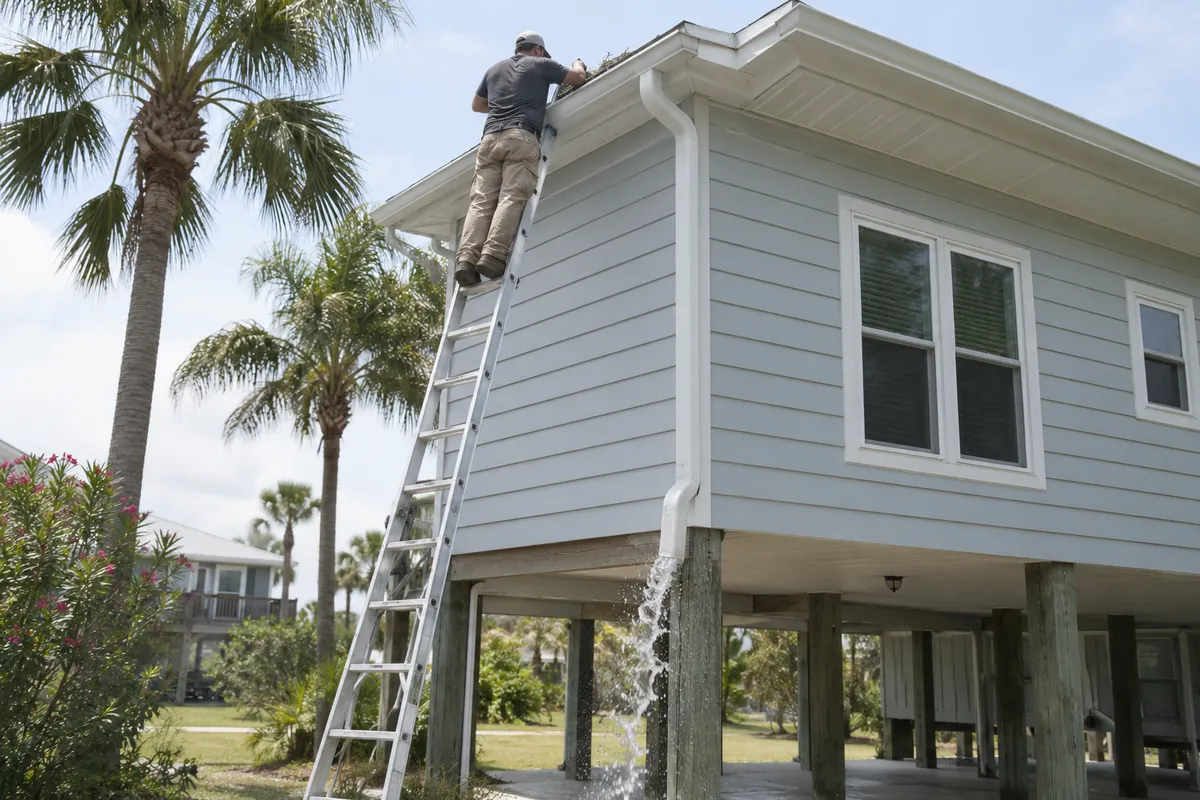
Gutter Services for Texas City Homes
Every service is tailored to the industrial exposure, coastal humidity, and flat-terrain drainage challenges specific to Texas City properties.
Gutter Installation
Seamless aluminum and Galvalume systems engineered for Texas City's industrial air quality and bay-side humidity. Proper sizing for Lago Mar new builds and full replacements for older Kohfeldt-area homes.
Learn More →Gutter Repair
Targeted fixes for corrosion damage, joint failures, and sagging sections caused by industrial particulate buildup and salt exposure from Galveston Bay. Hanger re-spacing for wind-damaged systems after storm season.
Learn More →Gutter Cleaning
Three-season cleaning schedules that account for live oak catkins, refinery soot accumulation, and post-hurricane debris. Includes downspout flushing and a visual corrosion inspection at every visit.
Learn More →Gutter Guards
Micro-mesh guard systems that block refinery particulate and live oak debris while maintaining full water flow during intense Gulf Coast downpours. Marine-grade options available for dike-adjacent properties.
Learn More →Downspout Services
Critical for Texas City's flat terrain. Extensions, underground drain tie-ins, and splash block placement engineered to move water well away from foundations on low-grade lots throughout the city.
Learn More →Ready to Protect Your Texas City Property?
Free estimates with transparent pricing—no pressure, no hidden fees.
Why Texas City Gutters Work Harder
Industrial emissions, bay-side salt air, flat terrain, and fifty inches of annual rainfall create one of the most punishing environments for gutter systems in Galveston County.
Texas City receives approximately 50 inches of rainfall annually, with the heaviest concentrations arriving between May and October when Gulf Coast thunderstorms can dump two to four inches in a single afternoon. That volume alone would challenge any gutter system, but the city's essentially flat topography amplifies the problem. Without meaningful natural grade to channel water away from structures, every inch of roof runoff must be captured by gutters and directed through downspouts to engineered discharge points. A gutter system that fails during a heavy rain event does not just overflow—it allows water to pool against foundations, saturate flower beds, and erode the thin topsoil layer that covers much of Texas City's clay-heavy subgrade.
The industrial corrosion factor adds a dimension that most coastal communities do not face. Sulfur dioxide and hydrogen sulfide emissions from nearby petrochemical operations mix with the region's high humidity to create a mildly acidic atmospheric condition that etches unprotected metal surfaces over time. Gutter contractors working in Texas City routinely observe accelerated pitting on standard aluminum gutters within five to seven years in the most exposure-heavy neighborhoods, compared to ten-plus years in communities like Friendswood or Santa Fe that sit farther from the refinery corridor.
Hurricane preparedness is non-negotiable. Texas City was directly impacted by Hurricane Ike in September 2008, when storm surge pushed bay water deep into residential neighborhoods and winds tore gutter systems from fascia boards across the city. More recently, Hurricane Beryl in 2024 reinforced the need for hurricane-rated mounting hardware. Hidden hangers spaced at 18 to 24 inches—rather than the standard 36-inch builder spacing—driven into rafter tails rather than just fascia, provide the structural anchoring needed to survive tropical-storm-force gusts that Texas City experiences every few years.
Salt exposure from Galveston Bay introduces the final variable. While not as intense as direct beachfront exposure on Galveston Island, the prevailing southeast breeze carries salt-laden moisture inland across Texas City's bayfront neighborhoods and the Dike area. That salt accumulates on gutter surfaces, accelerating corrosion especially at joints and end caps where protective coatings are most vulnerable. Periodic fresh-water rinsing—two to three times per year—helps clear deposits before they compromise the finish.
Texas City Quick Facts
- Annual Rainfall: ~50 inches, concentrated May–October
- Hurricane Risk: Direct Ike impact (2008); Beryl (2024)
- Industrial Exposure: Marathon & BP refinery corridor along Hwy 146
- Salt Air: Moderate—Galveston Bay proximity, SE prevailing winds
- Terrain: Flat; minimal natural drainage grade
- Soil Type: Clay-heavy subgrade; slow percolation
- Peak Storm Season: June through November
- Corrosion Timeline: 5–7 years (near refineries) vs. 10+ years inland
Nearby Communities Also Served
Galveston Clean Gutters serves Texas City and neighboring communities throughout Galveston County.
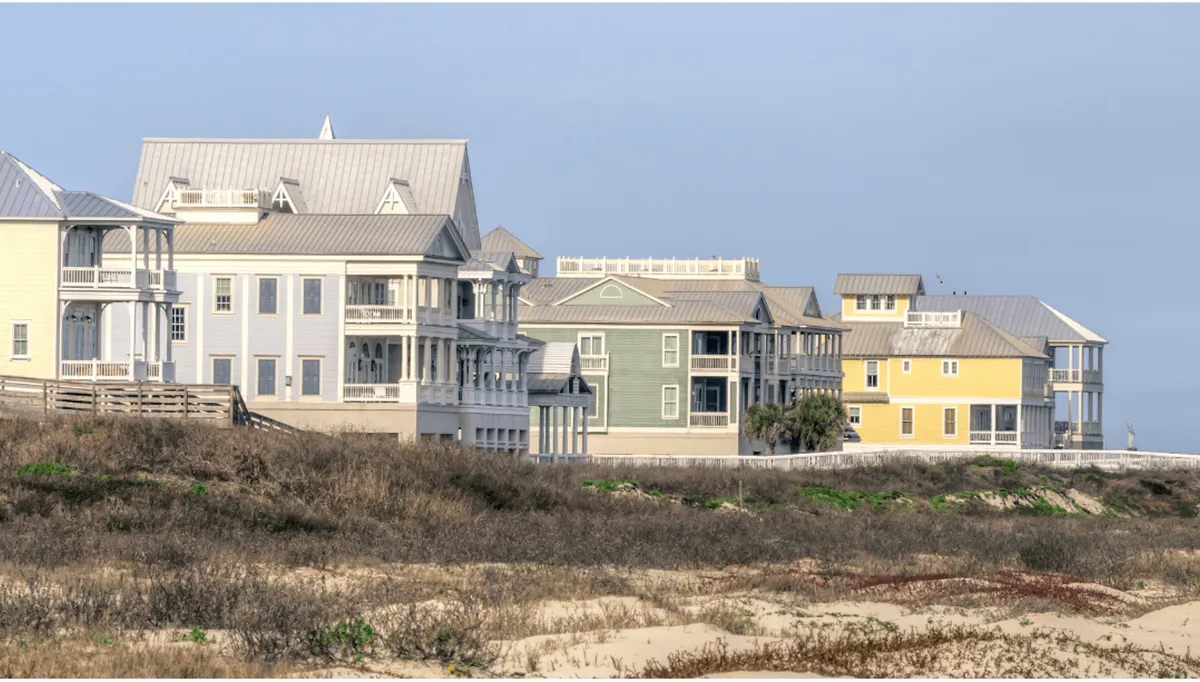
Protect Your Texas City Home from Water Damage
Industrial air, bay-side salt, and fifty inches of rain demand gutter systems built for the real conditions of this community. Connect with a qualified contractor today.
(409) 741-9557