Downspout Challenges Unique to the Texas Gulf Coast
The same coastal conditions that make Galveston County a desirable place to live also place extraordinary demands on residential drainage systems. Understanding the distinction between island and mainland soil behavior is the foundation of any effective downspout plan.
Elevated Pier-and-Beam Homes on the Island
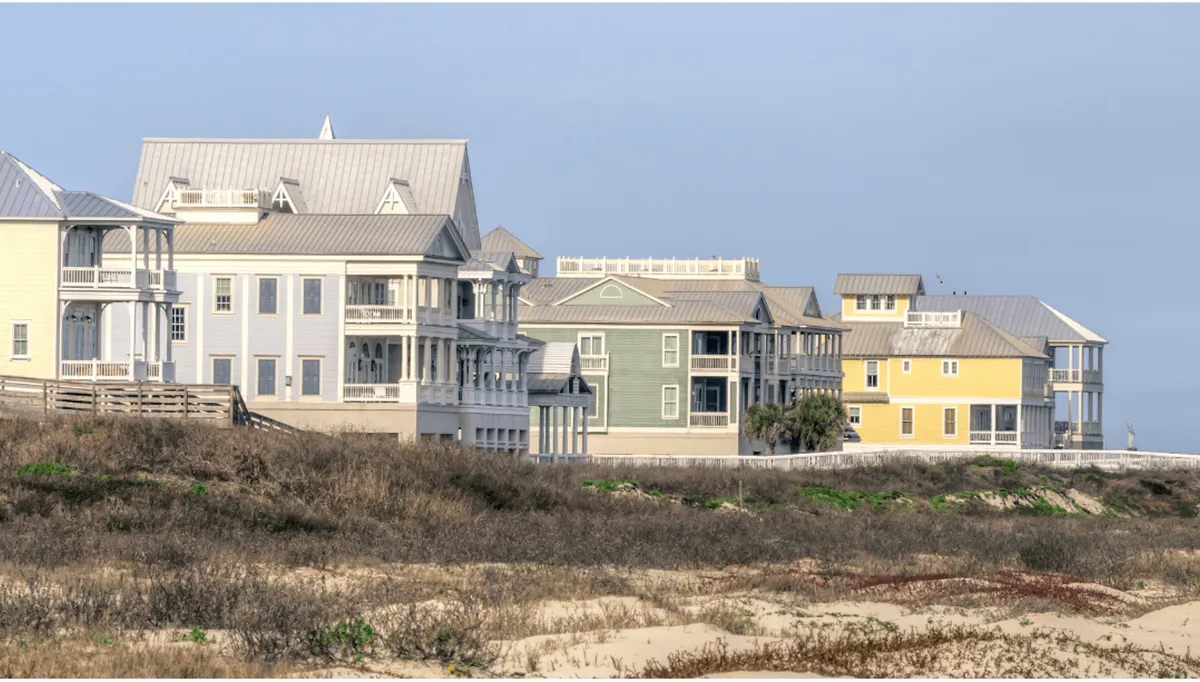
Thousands of homes across Galveston Island sit on raised pier-and-beam foundations, a construction method required by FEMA floodplain regulations and proven effective during major storm events like Hurricane Ike in 2008. The elevated design keeps living spaces above anticipated flood levels, but it also creates a significantly longer vertical run between the roofline and the ground, sometimes exceeding 15 to 20 feet.
That additional height translates directly into greater water velocity inside the downspout. During a typical Gulf Coast squall dumping two to three inches per hour, a standard 2x3-inch downspout on an elevated home can reach capacity almost instantly. The result is overflow at the gutter line, blowouts at elbow joints, and concentrated erosion around foundation pilings where high-velocity water slams into sandy soil.
The recommended solution for most elevated properties on the island is an oversized 3x4-inch rectangular downspout with reinforced aluminum elbows rated for coastal conditions. These larger-profile downspouts handle approximately 50 percent more volume per minute than standard sizes and distribute water energy more evenly at discharge points. Reinforced elbows with riveted seams replace the standard crimped connections that tend to separate under pressure on tall runs. Foundation piling protection at the base, typically a splash block or riprap pad, prevents scour channels from forming in the sandy substrate.
Mainland Drainage on Heavy Clay Soils
Cross the causeway into League City, Friendswood, or Texas City, and the ground beneath a homeowner's feet changes dramatically. Mainland Galveston County sits on heavy clay soils that expand when wet and contract when dry, a cycle that places constant stress on slab foundations. Unlike the island's sandy substrate, which drains rainwater quickly, clay holds moisture for extended periods and creates surface pooling that can persist for days after a heavy rain.
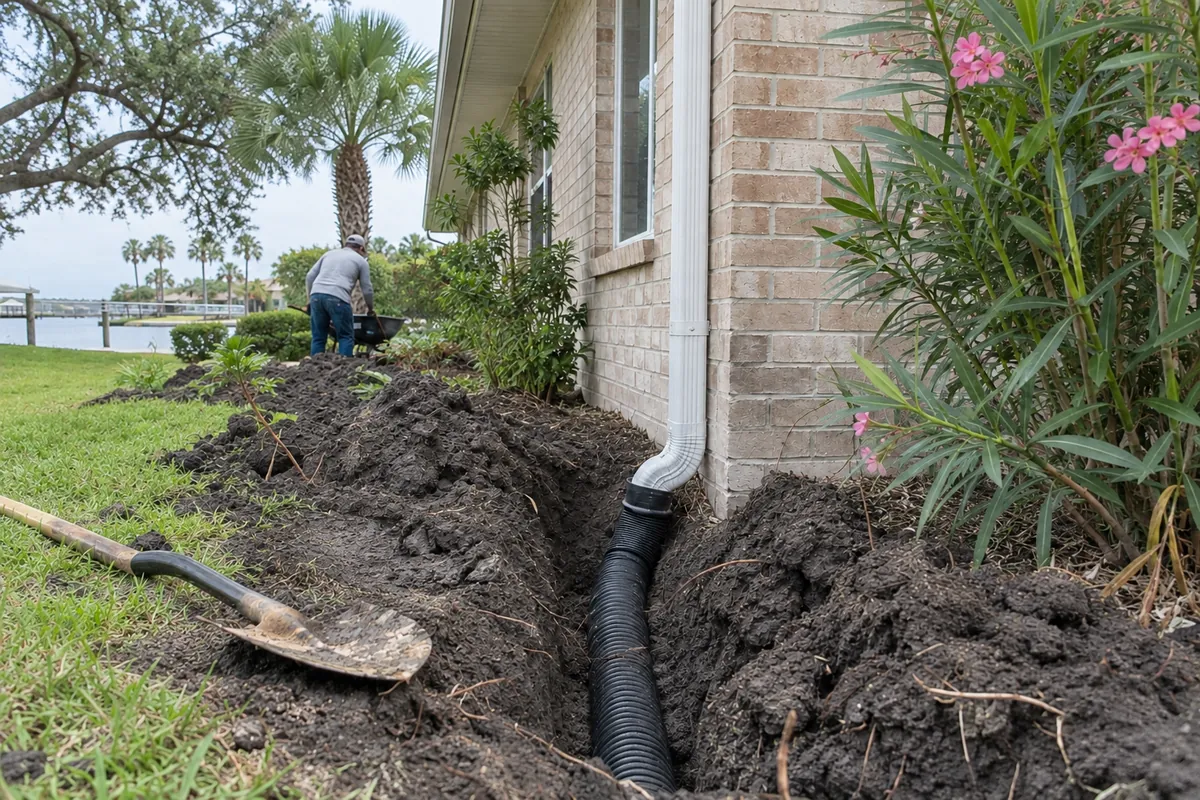
For mainland properties, downspout planning focuses on moving water as far from the foundation as possible before it has a chance to saturate the clay layer adjacent to the slab. Underground drainage extensions are frequently the most effective approach. A buried corrugated pipe or rigid PVC line carries roof runoff 8 to 15 feet away from the foundation, discharging through a pop-up emitter in the yard or into a dry well designed to disperse water gradually into the surrounding soil.
The contrast with island drainage strategy is stark. Sandy island soil absorbs water rapidly but erodes easily; clay mainland soil resists absorption but creates hydrostatic pressure against foundation walls when saturated. Both conditions demand professional assessment before downspout placement is finalized. A drainage plan designed for an elevated West End beach cottage would perform poorly on a League City slab home, and vice versa. Galveston Clean Gutters connects homeowners with contractors who understand both environments and tailor every downspout system to the specific soil, elevation, and roof area of the property.
According to structural engineering assessments across the Texas Gulf Coast, an estimated 85 percent of residential foundation problems can be traced back to poor drainage around the perimeter of the home. Properly sized and positioned downspouts are the single most cost-effective measure homeowners can take to prevent settlement, cracking, and hydrostatic pressure damage to both slab and pier-and-beam foundations in Galveston County.
Downspout Service Pricing in Galveston County
Pricing varies based on material, property elevation, soil conditions, and total linear footage. All estimates are free and provided on-site with no obligation.
| Service | Price Range | Notes |
|---|---|---|
| Standard Downspout Installation | $10 – $18 / LF | 2x3" rectangular, aluminum |
| Oversized 3x4" Downspout | $14 – $22 / LF | Recommended for elevated homes |
| Underground Extension | $15 – $25 / LF | Includes trenching, pipe, and pop-up emitter |
| Splash Block Installation | $25 – $50 / each | Concrete or plastic, positioned at discharge |
| Downspout Rerouting | $100 – $250 / run | New path with elbows and brackets |
| Elbow Replacement | $15 – $30 / each | Reinforced riveted seams for coastal use |
| Full Drainage System Design | Call for estimate | Custom assessment of soil, grade, and roof area |
All pricing reflects typical ranges for Galveston County residential properties. Actual costs depend on material selection, property elevation, accessibility, and total project scope. Coastal properties may carry a modest premium for corrosion-resistant hardware.
Schedule a Free Downspout Assessment
On-site evaluation of drainage conditions, soil type, and recommended downspout sizing for any Galveston County property.
Downspout Types for Coastal Properties
Each downspout profile serves a different purpose depending on roof area, property elevation, and local soil conditions. Selecting the right type is as important as selecting the right gutter size.
Standard 2x3" Rectangular
The industry standard for single-story slab homes with moderate roof areas. Handles up to 600 square feet of roof drainage per downspout. Best suited for mainland properties at ground level where water velocity remains manageable.
Oversized 3x4" Rectangular
Handles approximately 50 percent more volume than standard profiles. The preferred choice for elevated pier-and-beam homes on Galveston Island where long vertical runs generate high water velocity during tropical downpours. Reinforced elbows prevent blowouts.
Round Corrugated
A flexible option used primarily for utility structures, detached garages, and agricultural buildings. Not typically recommended for primary residential drainage along the Gulf Coast due to limited volume capacity and reduced resistance to salt-air corrosion at corrugation seams.
Underground Extensions
Buried PVC or corrugated pipe carries runoff 8 to 15 feet from the foundation. Essential for mainland clay-soil properties where surface pooling threatens slab integrity. Discharges through pop-up emitters or dry wells for controlled dispersal.
How Downspout Installation Works
A professional downspout installation follows a structured sequence designed to match the system to the property's specific drainage requirements, soil conditions, and elevation profile.
Drainage Assessment
A full inspection of existing gutters, downspout positions, discharge points, and visible erosion or pooling around the foundation.
Soil & Grade Analysis
Evaluation of soil type (sandy island vs. clay mainland), lot grading, and natural water flow patterns to determine optimal drainage strategy.
Downspout Sizing
Calculation of required downspout capacity based on total roof square footage, gutter size, vertical drop, and anticipated peak rainfall rates.
Path Planning
Selection of downspout routing that avoids windows, walkways, and landscaping while directing water to the most effective discharge location.
Installation
Precision mounting of downspouts with corrosion-resistant brackets secured to the structure at intervals of 6 to 8 feet for maximum stability.
Underground Routing
Where specified, trenching and installation of buried drainage pipe with proper slope grade, connected to pop-up emitters or dry wells.
Water Volume Testing
Simulated high-volume water flow through the completed system to verify capacity, check for leaks at joints, and confirm proper discharge.
Erosion Prevention
Installation of splash blocks, riprap pads, or gravel beds at discharge points to prevent soil scour and protect foundation pilings or slab edges.
Two Environments, Two Drainage Strategies
Galveston County spans a barrier island and a broad stretch of coastal mainland. The drainage requirements for each environment differ significantly, and a professional downspout system accounts for those differences from the first assessment.
Island Downspout Needs
- Elevated pier-and-beam construction creates long vertical downspout runs with high water velocity
- Sandy soil drains quickly but erodes easily around foundation pilings and fence posts
- Salt air accelerates corrosion on standard hardware, requiring marine-grade brackets and riveted elbows
- Oversized 3x4" downspouts recommended for most elevated homes to prevent overflow during tropical storms
- Splash blocks and riprap pads critical at discharge points to prevent scour channels in sandy substrate
- FEMA floodplain regulations may influence downspout routing and discharge placement on beachfront lots
Mainland Downspout Needs
- Slab-on-grade construction in League City, Friendswood, and Texas City requires perimeter drainage protection
- Heavy clay soils expand when wet and contract when dry, creating constant pressure on foundation edges
- Underground extensions with pop-up emitters move water 10 to 15 feet from the slab to prevent pooling
- Standard 2x3" downspouts adequate for most single-story homes when properly spaced
- Lot grading assessment essential to identify low spots where water naturally collects against the foundation
- Suburban lot density in newer subdivisions limits above-ground discharge options, favoring buried drainage lines
Not Sure Which Downspout System Fits?
A free on-site assessment determines the right size, material, and drainage approach for any Galveston County property.
Downspout Services FAQ
Answers to the most frequently asked questions about downspout installation, sizing, and drainage planning for Galveston County homes.
Elevated pier-and-beam homes throughout Galveston Island position the roofline significantly higher above ground level than slab-on-grade construction. That extra vertical drop increases water velocity inside downspouts, which places greater stress on elbows, seams, and ground-level discharge points. Standard 2x3-inch downspouts often cannot handle the volume and velocity produced during tropical downpours at that height. Oversized 3x4-inch rectangular downspouts with reinforced elbows are recommended for elevated properties to prevent blowouts, splash erosion around foundation pilings, and premature joint failure.
Standard downspout installation in Galveston County ranges from $10 to $18 per linear foot for 2x3-inch rectangular downspouts. Oversized 3x4-inch downspouts recommended for elevated homes run $14 to $22 per linear foot. Underground drainage extensions cost $15 to $25 per linear foot depending on soil conditions and trench depth. Splash block installation runs $25 to $50 each, and full downspout rerouting typically costs $100 to $250 per run. Coastal properties may see a modest premium due to corrosion-resistant hardware and the additional labor required for elevated pier-and-beam installations.
Most single-story slab-on-grade homes along the Gulf Coast perform well with standard 2x3-inch rectangular downspouts when properly spaced every 20 to 30 linear feet of gutter. However, elevated pier-and-beam homes common on Galveston Island benefit significantly from oversized 3x4-inch rectangular downspouts. The larger profile handles approximately 50 percent more water volume per minute, which is critical during the intense rainfall rates that accompany tropical storms and Gulf squalls. Round corrugated downspouts are occasionally used for utility buildings but are not recommended for primary residential drainage in coastal environments.
The answer depends on soil type and property elevation. On Galveston Island, where sandy soil drains quickly but can erode around pilings, above-ground discharge with properly positioned splash blocks is often the simplest and most effective approach. Mainland properties in League City, Friendswood, and Texas City sit on heavy clay soils that drain slowly, making underground extensions a better option to move water well away from the foundation and prevent pooling. Underground drainage lines typically extend 8 to 15 feet from the foundation and discharge into a pop-up emitter or dry well. A qualified drainage assessment determines the best approach for each property.
Downspouts should discharge water a minimum of 4 to 6 feet from the foundation, though 8 to 10 feet is recommended for Galveston County properties. On the island, sandy soil allows water to percolate quickly, but erosion around pier-and-beam pilings remains a concern if discharge is too close. On the mainland, clay soils require greater extension distances because water pools and migrates laterally before absorbing. Underground extensions with pop-up emitters positioned 10 to 15 feet from the foundation provide the most reliable protection against settlement and hydrostatic pressure damage.
In most cases, yes. Downspout rerouting involves disconnecting existing downspouts from their current outlet positions and reinstalling them along a new path, typically to redirect water away from walkways, driveways, landscaping, or problem drainage areas. The existing gutter system remains intact as long as the gutter outlets can be repositioned or new outlet holes can be cut. Rerouting runs typically cost $100 to $250 per downspout and include new elbows, extensions, and mounting brackets. A drainage assessment helps determine optimal new locations before any cutting or modification begins.
Galveston Island's sandy soil drains water rapidly compared to the heavy clay found on the mainland, which means standing water is rarely a problem in most areas. However, the fast drainage rate creates a different risk: erosion. Water discharged from downspouts can quickly wash away sandy soil around foundation pilings, fence posts, and landscaping. Splash blocks, riprap pads, or French drain systems at discharge points help disperse water energy and prevent scour channels. During tropical storms, saturated sandy soil can also shift, which makes proper downspout positioning and erosion barriers especially important for elevated pier-and-beam homes near the beachfront.