Why Galveston's Landscape Makes Guards Essential
Four Seasons of Debris, Twelve Months of Accumulation
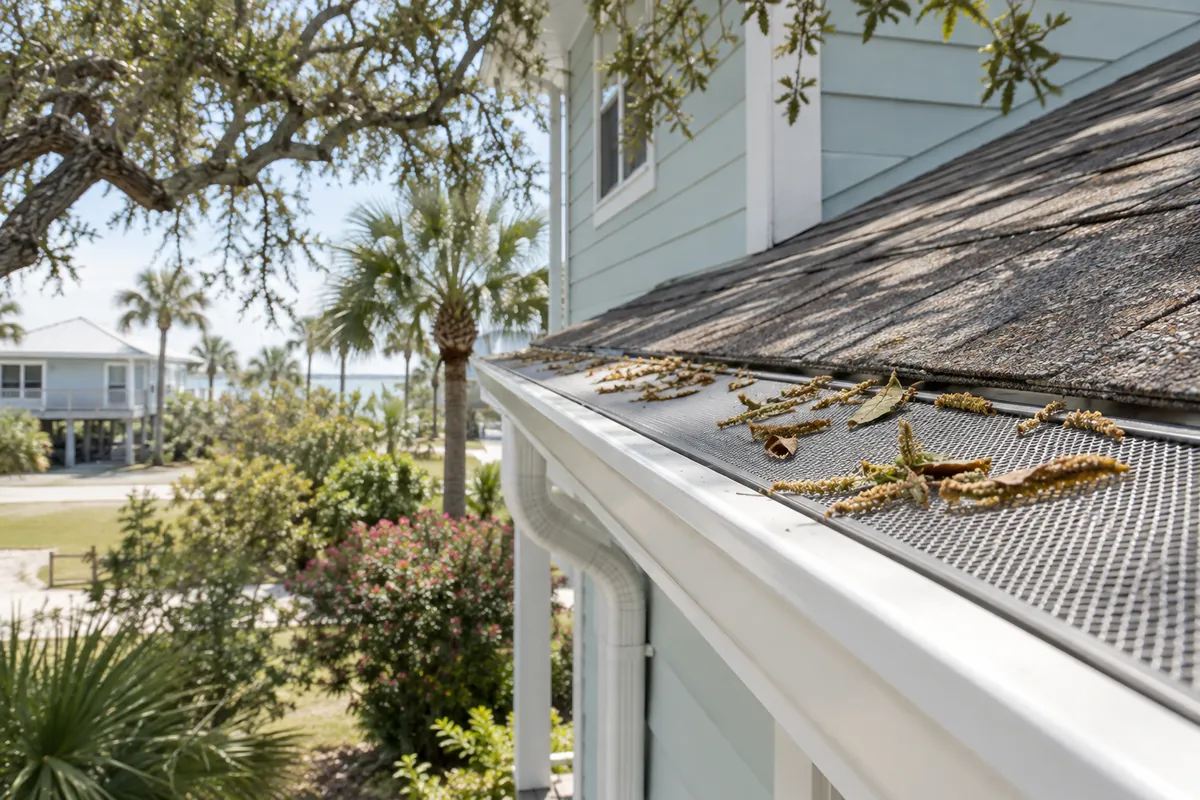
Galveston's subtropical canopy produces gutter-clogging debris on a cycle that never truly pauses. Live oaks, the island's most iconic shade tree, drop dense catkin clusters every spring. Unlike dry leaf litter that blows through open gutters, these catkins are sticky, pollen-laden clumps that compact into a thick mat when wet. A single mature live oak can fill an unprotected gutter trough within two weeks of peak catkin season.
Oleanders line residential streets and highway medians across the island, shedding narrow leaves and flower petals year-round. These fragments are small enough to pass through basic screen guards but large enough to accumulate at downspout openings, creating blockages that go unnoticed until a heavy rain event causes overflow. Palm fronds present a different challenge entirely: wind-sheared fragments lodge between gutter hangers and fascia boards, creating dams that trap smaller debris behind them.
Chinese tallow trees, classified as an invasive species but still common throughout Galveston County, drop waxy seed pods that resist decomposition. These pods roll along roof surfaces and drop directly into gutters, where their waxy coating makes them resistant to water flushing. For properties surrounded by multiple tree species, unguarded gutters may require cleaning four to five times per year just to maintain basic function.
Salt Corrosion Resistance and Storm Performance
Marine-Grade Materials for Island Conditions
Standard aluminum screen guards, the most common entry-level option nationwide, face accelerated corrosion when installed on Galveston Island properties. Constant salt-laden wind deposits a fine crystalline film on every exposed metal surface. On the island's Gulf-facing homes, this salt accumulation is measurable within days of a fresh-water rinse. Standard aluminum oxidizes under these conditions within three to five years, developing pinholes that allow debris to pass through and weakening the structural integrity of the guard itself.
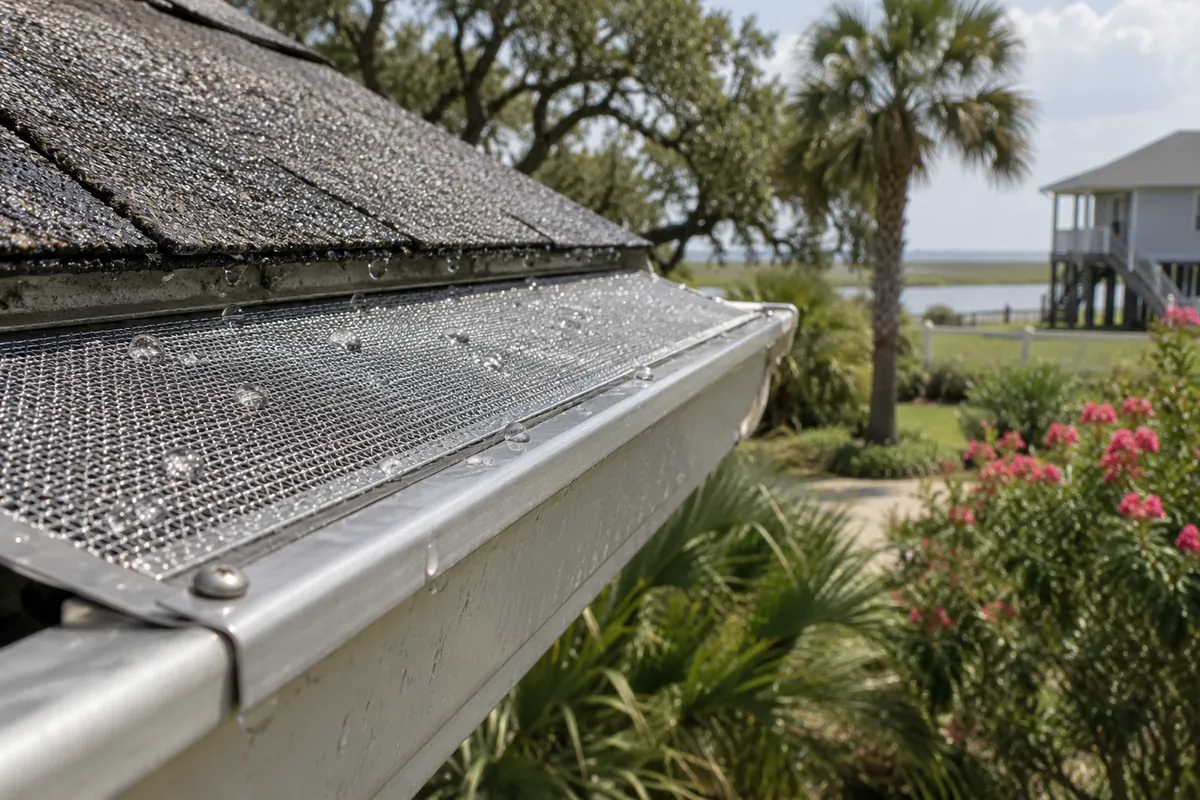
Marine-grade micro-mesh guards address this challenge by pairing surgical-grade stainless steel mesh with a powder-coated aluminum frame. The stainless steel mesh resists salt corrosion indefinitely under normal coastal exposure, while the powder coating on the frame provides a sealed barrier that prevents salt from reaching the raw aluminum substrate. This combination delivers 20-year or longer performance in salt air environments where uncoated aluminum fails in under five years.
Wind resistance is the second critical factor for Galveston guard selection. The island sits directly in the path of Gulf tropical systems, and every hurricane season tests the attachment strength of every exterior component on every roofline. Guards secured with self-tapping screws driven through the gutter lip and into the fascia board withstand sustained winds above 110 miles per hour. Snap-on and friction-fit systems, by contrast, showed widespread displacement during both Hurricane Ike in 2008 and Hurricane Beryl in 2024. For any island property, mechanically fastened guards are the only responsible recommendation.
Gutter Guard Pricing in Galveston
Pricing reflects installed cost per linear foot, including materials, labor, and gutter cleaning prior to installation. Coastal-grade options are highlighted for island properties.
| Guard Type | Price Range (per LF) | Best For | Coastal Rating |
|---|---|---|---|
| Basic Screen | $3 – $7 | Mainland properties with light debris | Moderate — not ideal for salt air |
| Aluminum Perforated Cover | $5 – $10 | Mainland homes near mature trees | Moderate — powder-coat recommended |
| Micro-Mesh Standard | $10 – $18 | Mainland and light-exposure island homes | Good — suitable for bay-side properties |
| Marine-Grade Micro-Mesh Coastal Pick | $15 – $30 | All island and beachfront properties | Excellent — stainless steel mesh |
| Reverse Curve | $12 – $22 | Properties prioritizing heavy-rain handling | Good — verify salt-rated coating |
Pricing varies by roof height, gutter condition, total linear footage, and coastal exposure level. Island properties typically see a 10 to 15 percent premium for corrosion-resistant fasteners and marine-grade materials. All estimates include pre-installation gutter cleaning and inspection. Contact Galveston Clean Gutters for a detailed, no-obligation quote.
For how guard costs fit into total gutter budgets, the Galveston gutter cost guide covers current county-wide pricing in detail.
Find the right guard system for any Galveston property.
Free estimates with material recommendations based on location and exposure level.
Five Guard Systems for Galveston Conditions
Each guard type offers distinct advantages depending on debris load, salt exposure, and budget. Here is how they compare for coastal properties.
Screen Guards
Basic metal or plastic mesh screens that sit over the gutter opening. The most affordable option, typically used as a temporary or budget-conscious solution for mainland homes with moderate debris.
Pros
- Lowest upfront cost ($3–$7/LF)
- Easy DIY installation
- Blocks large leaves and twigs
Cons
- Fine debris passes through openings
- Standard aluminum corrodes in salt air
- Wind uplift risk without screw mounting
Perforated Covers
Solid aluminum covers with rows of small perforations that allow water through while blocking most debris. A step up from basic screens, offering better coverage on homes with heavier tree canopy.
Pros
- Blocks most leaf and catkin debris
- More durable than basic screens
- Available with powder-coat finishes
Cons
- Small perforations can clog with pollen
- Reduced flow rate in heavy downpours
- Requires periodic surface cleaning
Micro-Mesh
Fine stainless steel or aluminum mesh bonded to a rigid frame. The mesh openings are small enough to block virtually all debris while maintaining strong water flow through surface tension.
Pros
- Blocks catkins, pollen, and seed pods
- Strong water flow during heavy rain
- Long lifespan with minimal maintenance
Cons
- Higher cost than screens or covers
- Standard aluminum mesh corrodes on island
- Professional installation recommended
Marine-Grade Micro-Mesh
Surgical-grade stainless steel mesh on a powder-coated aluminum frame, engineered specifically for salt air environments. The gold standard for Galveston Island and beachfront properties throughout the county.
Pros
- Corrosion-proof stainless steel mesh
- 20+ year coastal performance
- Handles 20+ inches/hour rainfall
- Mechanical fasteners resist hurricanes
Cons
- Highest upfront investment ($15–$30/LF)
- Requires professional installation
Reverse Curve
Solid covers with a curved nose that uses surface tension to direct water into a narrow slot while debris slides off the edge. Effective for heavy rainfall areas when properly sized.
Pros
- Excellent heavy-rain performance
- Self-cleaning design sheds large debris
- Durable solid construction
Cons
- Fine debris can enter the slot opening
- Visible profile changes roofline appearance
- Verify salt-rated coating for island use
Eight Steps to Complete Guard Protection
Professional gutter guard installation follows a systematic process designed to ensure proper fit, secure attachment, and optimal water flow for Galveston's demanding conditions.
Gutter Inspection
Full assessment of existing gutters, hangers, fascia boards, and downspout connections to identify any repairs needed before guard installation.
System Cleaning
Complete debris removal from all gutter troughs and downspout flushing to ensure a clean, unobstructed system before guards are fitted.
Guard Type Selection
Material recommendation based on the property's salt exposure level, surrounding vegetation, roof pitch, and existing gutter profile.
Custom Measurement
Precise measurement of every gutter run, including miters, end caps, and downspout openings, to ensure guards are cut to exact fit.
Trim & Fit
Guards are cut on-site to match each gutter section, with custom trimming around corners, end caps, and roof penetrations.
Secure Installation
Guards are mechanically fastened with self-tapping screws into the gutter lip and fascia board, meeting hurricane-rated wind resistance standards.
Water Flow Test
Controlled water testing across every guard section to verify proper drainage, confirm no ponding or overflow, and check downspout flow rates.
Maintenance Review
Walkthrough of recommended annual inspection schedule, surface cleaning technique, and seasonal considerations specific to the property's location.
Guards vs. No Guards on Galveston Properties
A side-by-side look at how gutter guard protection changes the maintenance equation for coastal homeowners.
With Gutter Guards
- One light maintenance visit per year instead of three to four full cleanings
- Live oak catkins, oleander debris, and palm fragments shed off the guard surface
- Fewer downspout blockages
- Gutter overflow during tropical downpours virtually eliminated
- Salt corrosion limited to the guard surface rather than accumulating inside the trough
- Fascia board rot from standing water no longer a recurring concern
- Hurricane-rated fasteners keep guards and gutters attached during high winds
- Annual maintenance cost drops from $450–$1,200 to under $150
Without Gutter Guards
- Three to four professional cleanings required per year, more near live oaks
- Catkin clumps compact into dense mats that resist water flushing
- Downspout blockages common after every major storm or wind event
- Gutter overflow during heavy rain erodes landscaping and stains siding
- Salt deposits accumulate inside the gutter trough, accelerating corrosion from within
- Standing water behind clogs saturates fascia boards, promoting wood rot
- Loose debris inside gutters becomes projectile hazard during hurricanes
- Annual maintenance cost of $450–$1,200 with no reduction over time
Ready to reduce gutter maintenance?
Free guard consultations with material samples and transparent pricing for every property type.
Gutter Guard Questions for Galveston Homeowners
Gutter guards deliver strong return on investment for Galveston properties. The island's live oaks produce dense catkin clumps every spring, oleanders shed flowers and leaves year-round, and palm fronds fragment during every storm. Without guards, most island homeowners need gutter cleaning three to four times per year at $150 to $300 per visit. Marine-grade micro-mesh guards cost $15 to $30 per linear foot installed but reduce cleaning frequency, typically paying for themselves within four to six years through reduced maintenance costs alone.
Marine-grade stainless steel micro-mesh guards are the top recommendation for properties exposed to salt air. Standard aluminum screen guards corrode within three to five years on Galveston Island due to constant salt deposition. Marine-grade micro-mesh uses surgical-grade stainless steel mesh bonded to a powder-coated aluminum frame, resisting salt corrosion for 20 or more years. For mainland properties in League City, Friendswood, or Texas City with less direct salt exposure, standard aluminum micro-mesh or perforated covers offer adequate performance at lower cost.
Gutter guard pricing in Galveston ranges from $3 to $7 per linear foot for basic screen guards, $5 to $10 for aluminum perforated covers, $10 to $18 for standard micro-mesh, $15 to $30 for marine-grade micro-mesh, and $12 to $22 for reverse-curve systems. Most Galveston homes require 120 to 180 linear feet of coverage, placing total project costs between $360 for basic screens and $5,400 for full marine-grade micro-mesh protection. Island properties typically see a 10 to 15 percent premium over mainland pricing due to corrosion-resistant materials.
Gutter guards significantly reduce but do not completely eliminate the need for maintenance. Even the best marine-grade micro-mesh systems benefit from an annual inspection and light surface brushing to clear salt film and any fine debris that accumulates on top of the mesh. Without guards, Galveston homes typically need three to four cleanings per year. With quality micro-mesh guards, that drops to one light maintenance visit annually. The guards also prevent the dangerous clogs that cause gutter overflow and fascia rot during tropical downpours.
High-quality micro-mesh and reverse-curve guards are engineered to handle rainfall rates of 20 or more inches per hour, well above the typical 6 to 8 inches per hour that Galveston experiences during tropical storms. The key is proper guard selection and installation. Micro-mesh guards with a surface tension design allow water to sheet into the gutter while debris slides off. Basic screen guards with larger openings may allow fine debris through during heavy rain. For Galveston properties, guards should be paired with 6-inch oversized gutters and adequately spaced downspouts to maximize flow capacity.
Properly installed gutter guards using mechanical fasteners and hurricane-rated mounting hardware withstand wind speeds of 110 miles per hour or more. The critical factor is installation method, not guard type. Guards secured with self-tapping screws into the gutter lip and fascia board perform significantly better than snap-on or friction-fit systems during high winds. After Hurricane Ike in 2008 and Hurricane Beryl in 2024, mechanically fastened guards showed minimal displacement compared to widespread failure of clip-on systems. Galveston installers increasingly specify screw-mounted systems as the default for all island properties.
Most gutter guard systems are designed for retrofit installation on existing 5-inch and 6-inch K-style gutters without requiring gutter replacement. The installation process begins with a thorough cleaning and inspection of the existing gutter system, followed by any needed repairs to hangers, seams, or fascia board. Guards are then custom-measured, trimmed, and secured to fit each gutter run. Half-round gutters, common on Galveston's historic homes, require specialty guard profiles but can also be fitted. The entire process typically takes one day for an average-sized home.