Why Galveston Island Demands Expert Gutter Service
Galveston Island occupies a position unlike any other community along the Texas coast. This 27-mile-long barrier island, barely two miles wide at its broadest point, sits fully exposed to the Gulf on its southern shore and faces Galveston Bay to the north. That geography means salt air reaches every structure on the island, not just beachfront properties. Corrosive salt spray carried by prevailing onshore winds coats metal surfaces year-round, accelerating oxidation on standard aluminum gutters and corroding unprotected steel fasteners at rates that would be unusual even a few miles inland. For homeowners across Galveston Island, gutter system material selection and protective coatings are not optional upgrades. They are baseline requirements for any installation expected to survive more than a handful of years.
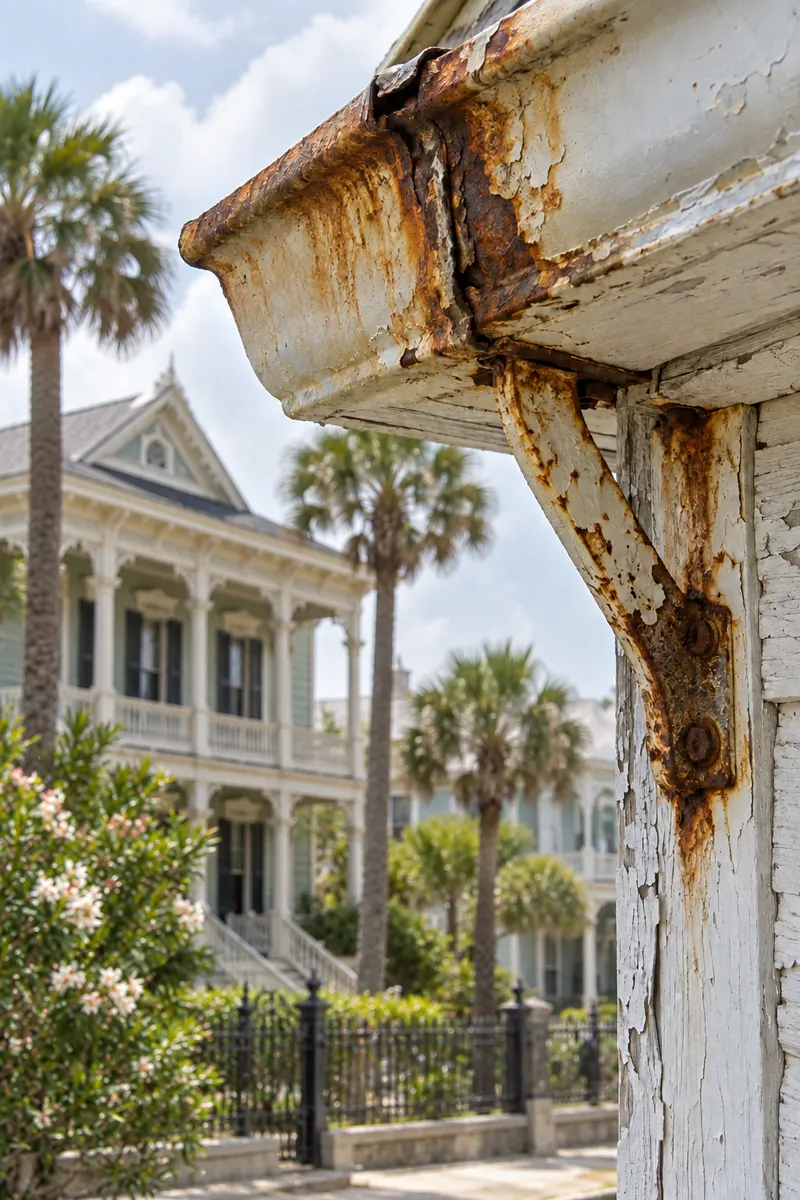
The East End Historic District, one of the largest collections of Victorian-era residential architecture in the United States, presents a particularly nuanced challenge. Homes in this district date to the 1870s through the early 1900s, and many feature ornate woodwork, wraparound galleries, and multi-level rooflines with dormers, turrets, and decorative brackets that complicate gutter routing. The Silk Stocking Historic District, immediately adjacent, carries similarly detailed architecture from the same era. Preserving the character of these homes while installing modern, high-performance gutter systems demands fabrication skills that go well beyond standard residential work. Half-round copper gutters, period-appropriate bracket styles, and custom downspout routing that avoids visually disrupting historic facades are standard considerations in these neighborhoods rather than luxury add-ons.
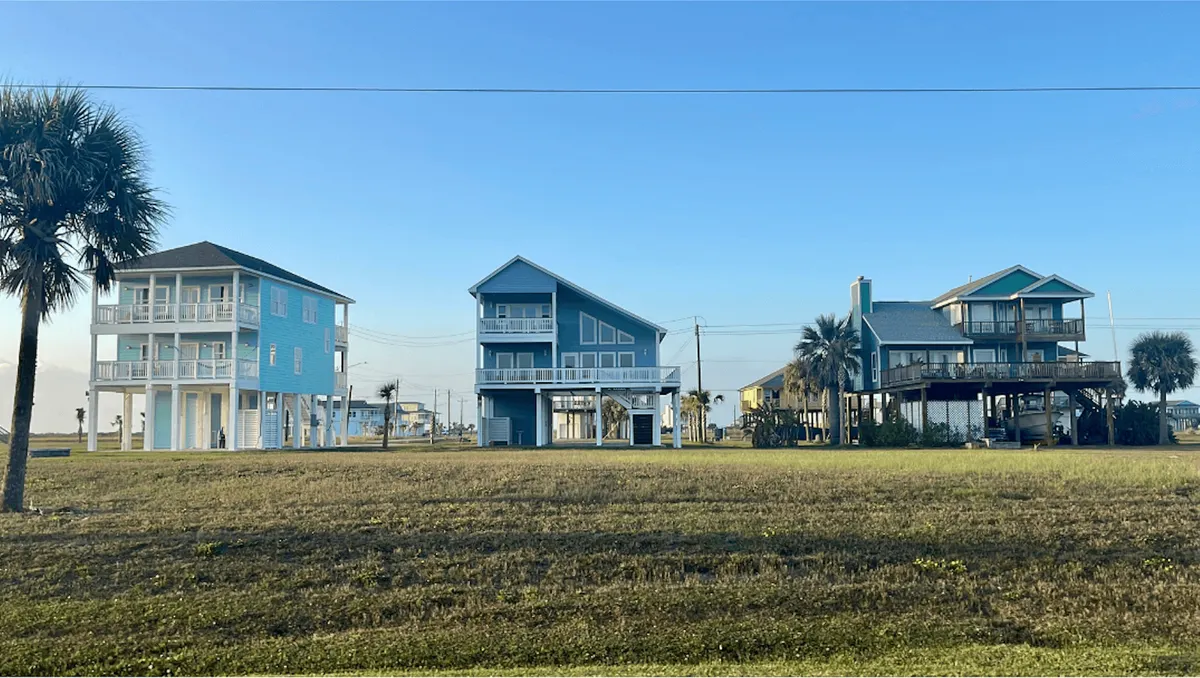
Moving west along the island, the architectural landscape shifts dramatically. The West End is dominated by elevated beach houses and newer construction built on pier-and-beam foundations that raise living spaces 10 to 15 feet above grade. These elevated structures present their own gutter engineering challenge: downspouts must traverse the full height of the pilings before reaching grade, and the discharge point needs to direct water away from the foundation pilings themselves without creating erosion channels in the sandy substrate beneath the structure. Many West End homes also feature expansive rooftop decks and multi-level construction where water from upper-level gutters cascades into lower systems, requiring careful capacity calculations to prevent overflow during heavy rain events.
The pier-and-beam construction common throughout Galveston Island, not just on the West End, introduces a drainage consideration that slab-on-grade communities simply do not face. When gutters overflow or downspouts fail to direct water far enough from the structure, that water pools beneath elevated homes and saturates the soil around foundation pilings. Over time, this saturation softens the ground that supports those pilings, potentially allowing differential settling that cracks walls, jams doors, and compromises the structural integrity of the entire home. In a community where a significant percentage of the housing stock sits on pier-and-beam foundations, functioning gutters are not cosmetic. They are structural protection. The island's position also means that every tropical weather system that enters the Gulf creates a direct threat. Gutter systems on Galveston Island must be fastened with hardware rated for sustained winds of 110 miles per hour or greater, with downspout brackets and strap connections that can withstand the uplift forces generated during hurricane-force gusts. Standard residential fastening schedules used in inland communities are simply inadequate for barrier island conditions.
Housing Stock Across Galveston Island
The Victorian-era homes concentrated in the East End and Silk Stocking districts represent some of the most architecturally significant residential structures on the Texas coast. Built predominantly between 1875 and 1910, these homes feature steeply pitched rooflines, complex intersecting gable configurations, and ornamental trim details that create dozens of water collection points along every roofline. Many homeowners in these districts specify copper or half-round gutter profiles to maintain the period-appropriate aesthetic, and the investment is justified not only by visual consistency but by copper's superior resistance to the salt air corrosion that degrades standard aluminum far more quickly in this environment. A copper gutter system on an East End Victorian can last 50 years or more with periodic maintenance, while standard aluminum in the same location may show significant corrosion within 8 to 12 years.
Mid-century ranch homes, built during Galveston's post-war residential expansion of the 1950s and 1960s, make up a substantial portion of the island's housing stock. These single-story structures feature simpler rooflines that are easier to service, but they sit on older pier-and-beam foundations that are particularly vulnerable to water damage from gutter failure. Many of these homes have original or first-replacement gutters that have exceeded their useful life and show visible sagging, separated seams, and corroded fasteners. For owners of these properties, a full gutter replacement with modern seamless aluminum and marine-grade stainless steel fasteners often represents the most cost-effective path forward, eliminating the cycle of patch repairs on a system that has fundamentally deteriorated.
New construction along the West End and scattered infill development throughout the island reflects current building codes that mandate elevated construction in flood zones. These homes sit on engineered pilings 12 to 18 feet above grade, with living spaces accessed by exterior staircases and covered parking areas beneath the structure. The gutter systems on these elevated homes carry a unique set of requirements: extended downspout runs that must be securely attached to pilings over their full length, splash blocks or underground drainage connections at grade level to prevent erosion around piling bases, and capacity sizing that accounts for the large roof surfaces typical of contemporary coastal construction. Six-inch gutters with oversized 3-by-4-inch downspouts are common specifications for West End beach houses, where a standard 5-inch system would be overwhelmed during the intense rainfall events that Galveston experiences multiple times each year.
Condominium complexes along Seawall Boulevard and the beachfront present yet another category of gutter work. These multi-story structures typically feature commercial-scale gutter systems that serve large sections of roof area, with internal downspouts routed through the building's wall cavities. Maintenance on these systems requires coordination with property management companies and often involves specialized access equipment to reach gutters on buildings three stories or taller. The salt exposure along the Seawall corridor is among the most intense on the island, and condo associations that defer gutter maintenance in this environment face accelerated deterioration that compounds in cost with every year of neglect.
Gutter Services Available on Galveston Island
Comprehensive gutter solutions engineered for barrier island conditions, from the East End Historic District to the West End beachfront.
Gutter Installation
Seamless aluminum and copper systems with marine-grade stainless steel fasteners, sized for Galveston Island's coastal exposure and hurricane-force wind ratings. Half-round profiles available for East End and Silk Stocking historic homes.
Learn More →Gutter Repair
Targeted repairs for salt-corroded seams, wind-damaged brackets, and sagging sections common throughout the island. Copper soldering and patina-matched patching for historic district homes requiring preservation-quality work.
Learn More →Gutter Cleaning
Full-system debris removal and flush testing to clear live oak catkins, oleander leaves, and salt residue buildup. Essential before hurricane season and after major storm events across Galveston Island.
Learn More →Gutter Guards
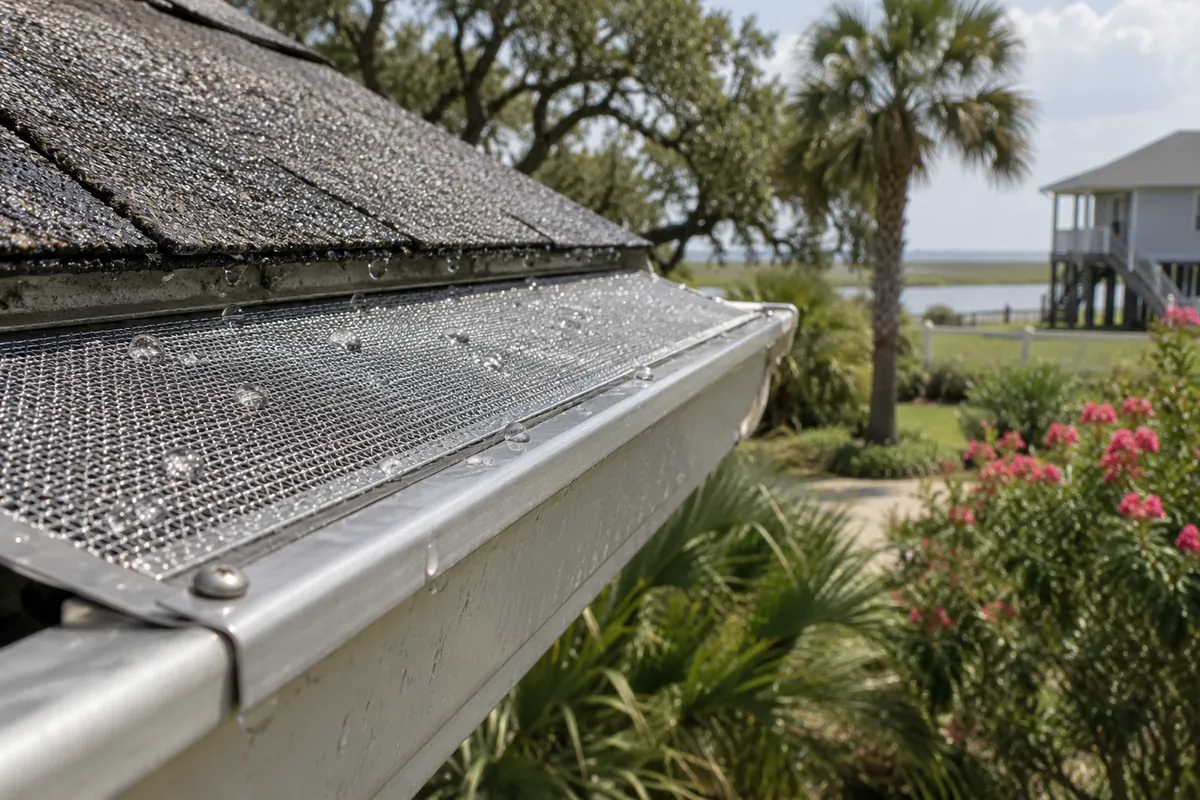
Marine-rated micro-mesh guard systems that block the fine live oak catkins and oleander debris prevalent across the island while maintaining full water flow during Galveston's intense coastal downpours.
Learn More →Downspout Services
Extended downspout runs for elevated pier-and-beam homes, underground drainage connections to protect West End piling foundations, and erosion-control discharge solutions for Galveston's sandy substrate.
Learn More →Have questions about island gutter systems?
No obligation — free estimates available Monday through Friday, 7AM–9PM.
Salt Air, Hurricanes, and Year-Round Debris on a Barrier Island
The single most persistent threat to gutter systems on Galveston Island is salt air corrosion. Unlike communities even a few miles inland where salt exposure is intermittent and weather-dependent, Galveston sits surrounded by saltwater on three sides. Prevailing onshore winds carry a fine mist of salt particles that deposits on every exterior surface, including gutter troughs, downspouts, brackets, and fasteners. Standard galvanized steel screws and hangers that would last 15 to 20 years in an inland installation can show visible rust within three to five years on the island. Marine-grade stainless steel fasteners and factory-finished aluminum with heavy-gauge coatings are not premium upgrades on Galveston Island — they are the minimum specification for any installation intended to deliver a reasonable service life.
Hurricane preparedness defines the gutter conversation on Galveston Island in a way that no inland community can fully appreciate. Hurricane Ike made direct landfall on the island in September 2008, driving a storm surge that inundated the entire city and wind gusts that exceeded 110 miles per hour. More recently, Hurricane Beryl struck the upper Texas coast in July 2024, bringing destructive winds and heavy rainfall that tested every gutter system on the island. These are not abstract risks. They are lived experiences that inform how gutter systems should be designed, fastened, and maintained. Bracket spacing on Galveston Island installations should not exceed 18 inches, compared to the 24- to 36-inch spacing common in protected inland areas, and every connection point should use screws rated for sustained wind loads rather than the nails or pop rivets that some contractors default to for speed.
Galveston Island receives approximately 50 inches of rainfall annually, arriving in patterns that range from slow winter frontal passages to explosive summer thunderstorms that can deliver two or more inches per hour. At that intensity, a standard 5-inch K-style gutter operating at full capacity will overflow within minutes unless downspout sizing and placement are calculated for peak flow rather than average conditions. The island's flat topography compounds the drainage challenge — there is virtually no natural grade to assist runoff, and standing water around foundations is a chronic issue during prolonged rain events. Oversized 6-inch gutters with 3-by-4-inch downspouts spaced no more than 30 feet apart represent the practical standard for Galveston Island installations, particularly on homes with roof surfaces exceeding 1,500 square feet.
The island's subtropical vegetation creates a debris load that peaks in spring but never fully relents. Live oak trees, which dominate the Galveston canopy, drop catkins in massive quantities during March and April — fine, string-like seed clusters that pass through standard gutter screens and accumulate into dense mats that block water flow. Oleander, one of the most common ornamental plantings on the island, sheds leaves and flower debris throughout the growing season. Palm fronds, though less frequent, create blockages at downspout inlets when they fall. The combination of organic debris and salt residue creates a corrosive slurry inside gutter troughs that accelerates deterioration of both the gutter material and the protective coating on the interior surface. Regular cleaning — at minimum twice per year, with an additional cleaning before hurricane season — is essential to prevent both flow obstruction and premature material failure.
Humidity on Galveston Island ranges from 75 to 81 percent for much of the year, creating conditions where moisture lingers on every surface and accelerates both corrosion and biological growth. Algae, mildew, and mold establish on gutter exteriors quickly in this environment, particularly on north-facing surfaces that receive limited direct sunlight. While biological growth does not directly impair gutter function, it does accelerate the degradation of painted and coated surfaces, shortening the interval between necessary maintenance and increasing the likelihood that small cosmetic issues evolve into structural ones. For pier-and-beam homes, the humidity beneath the structure adds another dimension — downspout discharge that pools under the home creates a perpetually damp environment that promotes wood rot in floor joists and subfloor materials unless drainage is directed well away from the building footprint.
Galveston Island Quick Facts
- Salt air corrosion: Constant, year-round exposure on all surfaces
- Hurricane history: Ike (2008), Beryl (2024) — direct island impacts
- Annual rainfall: Approximately 50 inches, with intense summer storms
- Live oak catkins: Heavy spring drop clogs standard gutter screens
- Oleander debris: Leaf and flower drop throughout growing season
- Humidity: 75–81% year-round, accelerating corrosion and mold growth
- Pier-and-beam drainage: Extended downspout runs required on elevated homes
Nearby Service Areas
Galveston Clean Gutters provides professional gutter services across Galveston County and the surrounding mainland communities.
Protect Your Island Home from Coastal Water Damage
Free estimates and transparent pricing on every gutter project, from routine cleaning to full copper system installation on historic homes.
Call For Free Estimate