Why Bolivar Peninsula Demands the Highest Standard of Gutter Protection
Bolivar Peninsula is the most Gulf-exposed residential area in Galveston County, and it is not a close contest. This narrow strip of land extends roughly 27 miles from Port Bolivar at its western tip to High Island at its eastern terminus, with open Gulf water along the entire southern shore and the shallow tidal flats of East Bay to the north. Unlike Galveston Island, which benefits from the partial protection of the Galveston Seawall and the mass of the island itself, Bolivar Peninsula sits low, narrow, and almost entirely unshielded from the forces that roll in off the open water. Salt air exposure on the peninsula is the most intense in the entire Galveston Clean Gutters service area, and it is relentless. Prevailing southeast winds carry salt-laden moisture across the full width of the peninsula, coating every exterior surface in a fine saline film that accelerates metal corrosion at rates substantially higher than those measured even on the more protected north shore of Galveston Island.
The communities that dot Bolivar Peninsula are small, spread out, and distinct in character. Crystal Beach is the largest and most established residential concentration, serving as the commercial and social center of the peninsula. Port Bolivar, at the western ferry landing, is the gateway for anyone arriving from Galveston Island. Caplen and Gilchrist occupy the central stretch, where development is sparser and the landscape feels more remote. High Island, at the far eastern end, is technically in Chambers County but serves as the peninsula's eastern anchor and is known primarily for its Audubon Society bird sanctuaries rather than dense residential development. Across all of these communities, the housing stock and the environmental stresses on that housing stock share a common thread: direct Gulf exposure, extreme salt air, hurricane vulnerability, and limited access to service providers willing to make the trip.
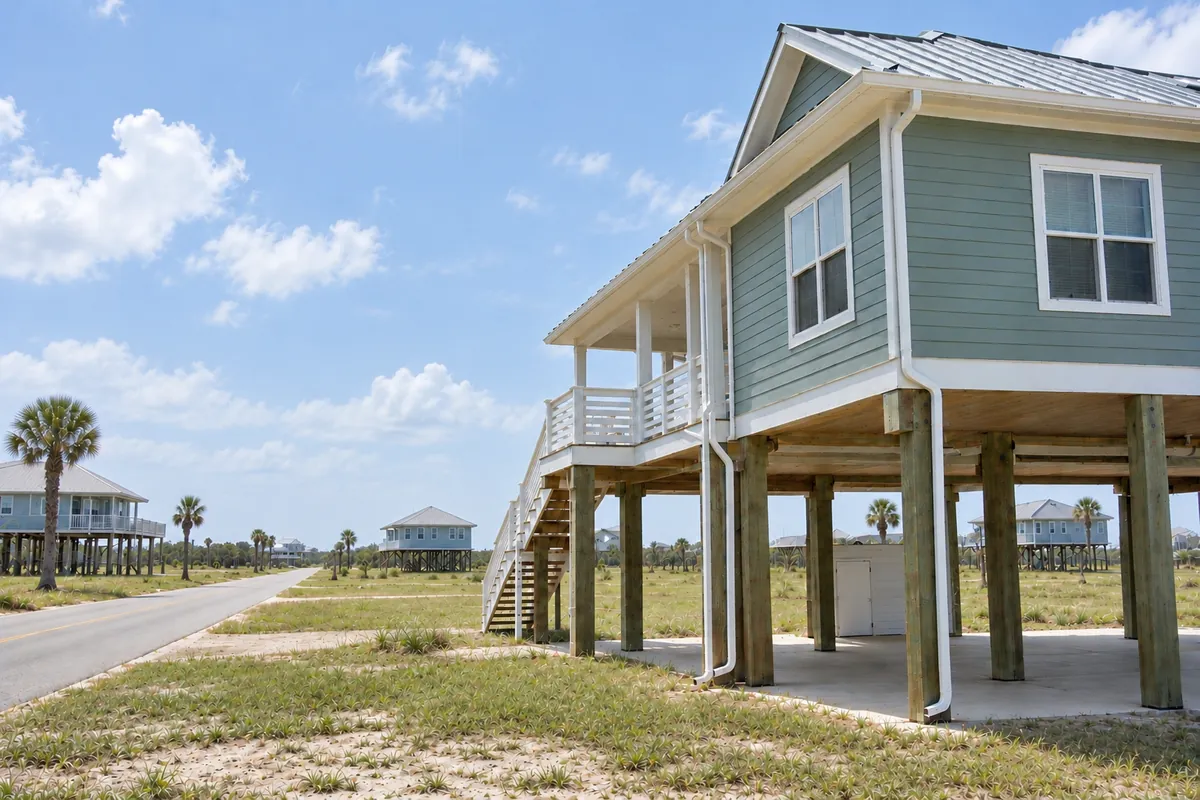
Hurricane Ike in September 2008 fundamentally reshaped Bolivar Peninsula in a way that no other recent storm has altered any community in Galveston County. The Category 2 hurricane drove a storm surge of approximately 15 to 20 feet across the peninsula, and virtually every structure was either destroyed outright or damaged beyond economical repair. Pre-Ike photographs of Crystal Beach and Gilchrist show dense rows of single-story beach cottages and older wood-frame homes sitting near grade level. Post-Ike, those structures are gone. The peninsula that exists today has been almost entirely rebuilt, and that rebuilding has followed modern coastal building codes that mandate elevated construction. The result is a community where nearly every residential structure sits on engineered pilings, raised 12 to 16 feet above ground level, with living spaces accessed by exterior staircases and open parking areas or storage beneath the elevated floor.
This elevated construction profile creates a gutter engineering challenge unlike anything found in conventional mainland communities. Downspouts on a peninsula home do not simply drop from the roofline to grade level over a distance of eight or ten feet, as they would on a slab-on-grade house in Dickinson or Santa Fe. Instead, downspouts must traverse the full height of the structure, from the roofline down past the elevated living area, past the piling supports, and finally to grade level — a vertical run that commonly reaches 25 to 30 feet. These extended downspout runs require robust bracket attachments at regular intervals to prevent the weight of water in the downspout from pulling connections apart during heavy rain events. The discharge point at grade level also demands careful attention, because water dumped at the base of pilings can erode the sandy soil that supports those pilings and compromise the structural foundation over time.
Salt Exposure and Material Selection
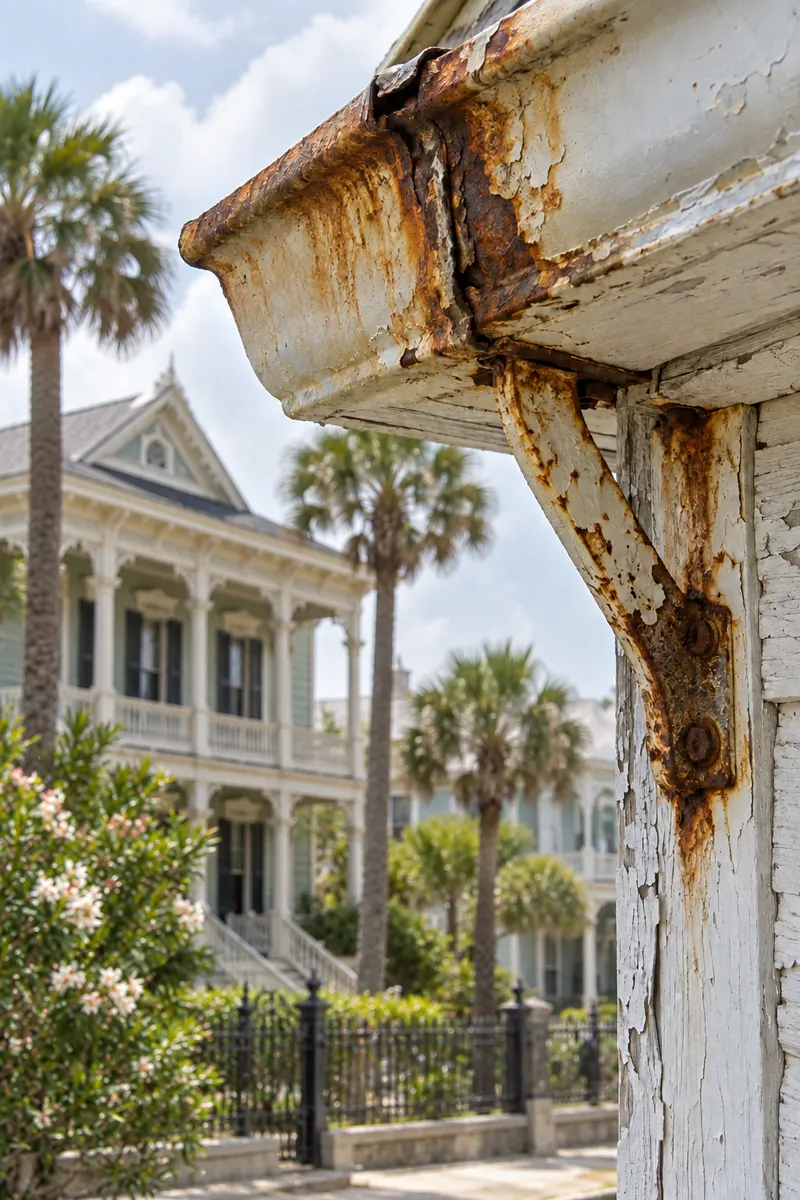
The intensity of salt air exposure on Bolivar Peninsula makes material selection for gutter systems a decision with significant financial consequences. Standard painted aluminum gutters, which perform adequately in inland communities for 15 to 20 years, can show visible corrosion within five to eight years on the peninsula. The salt spray does not merely coat the exterior surface — it penetrates seams, collects in bracket connections, and deposits in the trough interior where standing water after rain events creates a saline bath that attacks the metal from the inside. Galvalume-coated steel and copper are the materials most strongly recommended for peninsula installations. Galvalume, an aluminum-zinc alloy coating over steel, provides substantially better corrosion resistance than standard aluminum at a moderate cost premium. Copper, while more expensive at initial installation, offers the longest service life in salt air environments and develops a natural patina that protects the underlying metal rather than degrading it. For homeowners investing in a structure that was built to withstand the next major hurricane, specifying gutter materials that can survive the same conditions is a logical and cost-effective decision over the full life of the home.
Fasteners deserve equal attention. Stainless steel screws and brackets are the minimum acceptable specification for any gutter installation on Bolivar Peninsula. Standard galvanized fasteners will show rust within two to three years in this environment, and once a fastener begins to corrode, the connection it secures becomes progressively weaker. A single failed bracket on an extended downspout run can allow the entire run to separate from the structure during a wind event, converting a minor maintenance issue into a major repair. Marine-grade 316 stainless steel fasteners, while carrying a price premium of roughly 40 to 60 percent over galvanized alternatives, eliminate this failure mode and are considered standard practice for peninsula construction.
The Rebuilt Peninsula: Elevated Homes and Unique Service Demands
The housing stock on Bolivar Peninsula is among the newest in Galveston County, not because of a recent construction boom driven by market demand, but because Hurricane Ike erased nearly everything that existed before September 2008. The peninsula that homeowners and visitors see today is a product of post-disaster rebuilding governed by updated FEMA flood maps and Texas Windstorm Insurance Association (TWIA) requirements that mandate elevated construction in designated flood zones. Almost every residential structure on the peninsula now sits on pilings that raise the lowest habitable floor 12 to 16 feet above grade, with some properties in higher-risk areas elevated even further. This uniformity of construction style creates a service area where the gutter challenges are remarkably consistent from Crystal Beach to Gilchrist: elevated rooflines, extended vertical downspout runs, exposure to the most intense salt air in the county, and the structural reality that every home is designed to let storm surge pass beneath the living space rather than resist it.
Vacation rental properties account for a significant portion of the peninsula's housing stock, particularly in Crystal Beach where short-term rentals generate the economic activity that supports local businesses. These rental homes are typically larger than full-time residences, with multiple bedrooms, expansive covered decks, and roof surfaces that collect substantial volumes of water during rain events. The gutter systems on these properties work harder than those on smaller homes, handling greater water volumes across longer trough runs, and they are also subject to the deferred maintenance that sometimes accompanies absentee ownership. Property management companies that oversee dozens of rental homes on the peninsula often lack the specialized knowledge to identify gutter issues before they escalate, and the seasonal nature of rental occupancy means problems that develop during the off-season can go unnoticed for months. Regular maintenance agreements with a qualified gutter service provider are particularly valuable for this category of property.
Full-time residents on the peninsula face a different version of the same fundamental challenge: limited local service availability. Bolivar Peninsula does not have the population density to support a large ecosystem of home service contractors the way League City or Texas City does. Reaching the peninsula requires either a ferry crossing from Galveston Island, with wait times that can stretch to an hour or more during peak periods, or a drive east along Highway 87 from the Winnie and High Island direction. Many mainland contractors are reluctant to serve the peninsula because of the travel time involved, which means homeowners who defer maintenance risk waiting weeks or longer for a service appointment when a problem does arise. Galveston Clean Gutters serves the full length of Bolivar Peninsula, from Port Bolivar to High Island, providing the consistent service availability that peninsula homeowners need to keep gutter systems functioning in one of the most demanding coastal environments on the Texas coast.
The sandy substrate that underlies the entire peninsula adds another dimension to gutter system design. Unlike the clay soils common in mainland communities, the loose sand on Bolivar Peninsula does not hold its shape when saturated. Downspout discharge that pools at the base of pilings can create scour channels that undermine the soil supporting the foundation. Splash blocks alone are often insufficient in this environment; underground drain lines that route water at least six to eight feet away from the nearest piling are the recommended best practice. For properties on lots that slope toward neighboring structures, French drain connections or pop-up emitters may be necessary to prevent one home's gutter discharge from becoming a neighboring property's foundation problem.
Gutter Services Available on Bolivar Peninsula
Salt-resistant, hurricane-rated gutter solutions engineered for the most exposed barrier peninsula in Galveston County, from Crystal Beach to High Island.
Gutter Installation
Galvalume and copper gutter systems with marine-grade 316 stainless steel fasteners, sized and rated for Bolivar Peninsula's extreme salt exposure and hurricane-force wind conditions. Extended downspout runs engineered for elevated piling construction.
Learn More →Gutter Repair
Targeted repairs for salt-corroded seams, wind-damaged brackets, and separated downspout connections on elevated peninsula homes. Full inspection of fastener integrity on extended vertical runs where corrosion-driven failure is most common.
Learn More →Gutter Cleaning
Complete debris removal and salt residue flushing for peninsula gutters exposed to the heaviest salt deposition in the service area. Essential before hurricane season and critical for vacation rental properties between guest turnovers.
Learn More →Gutter Guards
Marine-rated micro-mesh guard systems that withstand peninsula wind loads while blocking windblown debris and salt crystal buildup. Stainless steel mesh construction resists the accelerated corrosion unique to direct Gulf exposure.
Learn More →Downspout Services
Extended 25-to-30-foot downspout runs for elevated piling homes, with heavy-duty bracket systems at 4-foot intervals and underground drainage connections that protect sandy peninsula foundations from scour erosion.
Learn More →Need gutter service on the peninsula?
No obligation — free estimates available for Crystal Beach through High Island.
The Most Demanding Gutter Environment on the Texas Coast
Bolivar Peninsula occupies the most exposed position of any residential community served by Galveston Clean Gutters, and the environmental data supports that distinction at every level. The peninsula faces the open Gulf along its entire southern shoreline with no seawall, no jetty system, and no offshore barrier islands to diffuse wave energy or reduce salt spray. During periods of sustained onshore winds, which occur for the majority of the year, salt-laden air moves unobstructed across the narrow peninsula, depositing a corrosive film on every exterior surface. Gutter systems on the Gulf-facing side of peninsula homes absorb the heaviest salt deposition, but the peninsula is narrow enough that north-facing surfaces receive nearly equivalent exposure. There is no sheltered side on Bolivar Peninsula.
Hurricane Ike's impact on the peninsula in 2008 remains the defining event in how structures are built, maintained, and insured on Bolivar. The storm drove a surge estimated between 15 and 20 feet across the entire peninsula, and winds gusted above 110 miles per hour for hours. Every structure that was not elevated on pilings was destroyed. The rebuilding that followed incorporated wind-load engineering that is among the most stringent of any residential construction in Texas. Gutter systems on these post-Ike structures must meet the same standard. Bracket spacing on peninsula installations should not exceed 16 inches, tighter than the 18-inch maximum recommended for Galveston Island, and every fastener must be rated for sustained wind loads of 120 miles per hour or greater. Strap-style downspout brackets, which wrap completely around the downspout pipe, are strongly recommended over clip-style brackets that can allow the pipe to separate during uplift events.
Annual rainfall on Bolivar Peninsula averages approximately 50 inches, comparable to the rest of Galveston County, but the delivery pattern is what matters for gutter system design. Summer convective storms routinely produce rainfall rates exceeding two inches per hour, concentrated in bursts that last 20 to 40 minutes. At that intensity, a standard 5-inch gutter operating at maximum capacity will overflow within minutes. The 6-inch gutter profile with oversized 3-by-4-inch downspouts is the recommended minimum specification for peninsula installations, and homes with roof surfaces exceeding 2,000 square feet may require additional downspout outlets to handle peak flow conditions without overflow. The penalty for undersized gutters on an elevated piling home is not merely cosmetic — overflow water cascading from the roofline to the ground 20 or more feet below creates concentrated erosion points around pilings that can compromise the foundation over time.
The remote location of Bolivar Peninsula introduces a practical dimension to gutter maintenance that homeowners in more accessible communities do not face. When a gutter system fails during a major storm event — a bracket pulls loose, a downspout separates, a trough section collapses under debris weight — the repair cannot wait weeks for a contractor to schedule a trip across the ferry. Storm damage to gutters that goes unrepaired allows subsequent rain events to compound the problem, directing uncontrolled water flow against the structure and accelerating erosion around the foundation. Maintaining a proactive service relationship with a gutter provider that serves the full peninsula, rather than waiting for catastrophic failure to seek help, is the most effective strategy for protecting both the gutter investment and the structure it serves.
Bolivar Peninsula Quick Facts
- Salt exposure: Most intense in the entire Galveston County service area
- Gulf frontage: 27 miles of direct, unshielded open-water coastline
- Hurricane Ike (2008): 15–20 ft surge; virtually all structures destroyed
- Construction type: Almost entirely post-Ike elevated homes on pilings (12–16 ft)
- Annual rainfall: Approximately 50 inches, with intense summer storms
- Wind exposure: No seawall or barrier protection; 120+ mph design standard
- Access: Ferry from Galveston or Hwy 87 from the east; limited service availability
Nearby Service Areas
Galveston Clean Gutters provides professional gutter services across Galveston County and the surrounding mainland communities.
Protect Your Peninsula Home from Gulf Coast Elements
Free estimates and transparent pricing on every gutter project, from routine cleaning to full Galvalume or copper system installation on elevated peninsula homes.
Call For Free Estimate