The West End's Tightest Community
Jamaica Beach occupies a narrow stretch of Galveston Island's West End, roughly 10 miles southwest of downtown Galveston along FM 3005. With a population hovering around 1,000 year-round residents, it holds the distinction of being the smallest incorporated city on Galveston Island and one of the smallest in the entire state of Texas. The community is entirely residential. There is no commercial district, no strip mall corridor, no downtown block of storefronts. Every structure within the city limits is a home, a vacation rental, or a piece of community infrastructure like the city hall or the volunteer fire station. That exclusively residential character means gutter maintenance across Jamaica Beach falls entirely on individual homeowners and property managers, with no commercial property management companies handling large-scale building upkeep that might set maintenance standards for the broader community.
Geography defines everything about Jamaica Beach's relationship with water. The city sits on a section of the island that is barely a quarter-mile wide in some places, with the Gulf shoreline to the south and West Bay to the north. There is no natural elevation to speak of — the highest ground in Jamaica Beach without man-made fill sits just a few feet above sea level. That reality, combined with the community's direct frontline position on the Gulf, means storm surge is not a hypothetical risk. It is the central fact of life that shapes every building decision. Hurricane Ike in September 2008 delivered a storm surge that inundated Jamaica Beach completely, destroying or severely damaging a large percentage of the housing stock. The rebuilding that followed transformed the community's physical appearance almost entirely, replacing the older single-story beach cottages that had characterized the neighborhood with elevated structures on engineered pilings that raise living spaces 14 to 18 feet above grade.
The post-Ike building codes enforced by the City of Jamaica Beach mandate strict elevation requirements that exceed FEMA minimums in many cases. Every new home and every substantially rebuilt structure must sit on pilings that place the lowest habitable floor well above the base flood elevation. The result is a community where virtually every home stands on tall stilts, with covered parking, storage, and utility connections at ground level and all living space accessed by exterior staircases that climb to the elevated first floor. For gutter systems, this universal elevation creates a challenge that is fundamentally different from what contractors encounter in ground-level communities. Downspouts on a Jamaica Beach home must run the full height of the pilings — often 15 feet or more — before reaching grade, and the discharge point at the bottom must direct water away from the piling footings without creating erosion channels in the sandy soil that surrounds each foundation element.
Salt air exposure in Jamaica Beach is as intense as anywhere on Galveston Island, and arguably more severe than in the more sheltered eastern sections of the island near the Seawall. The West End has no seawall protection. There are no high-rise condominiums or commercial structures to break the wind. Onshore breezes carry salt spray directly from the Gulf across the low dunes and into the residential streets without obstruction. Every metal surface on every home in Jamaica Beach — including gutter troughs, downspouts, brackets, hangers, and fasteners — sits in a continuous salt bath that accelerates corrosion far beyond what identical materials experience even a few miles inland along the I-45 corridor. Standard aluminum gutters with galvanized steel fasteners, a perfectly adequate specification for communities like League City or Friendswood, will show visible degradation within five to seven years in Jamaica Beach. Marine-grade stainless steel fasteners and heavy-gauge factory-coated aluminum represent the minimum viable specification for any gutter installation expected to deliver a reasonable service life in this environment.
The community's compact size creates an unusual advantage for gutter service logistics. Because Jamaica Beach spans only a few blocks in width and roughly two miles in length, a service crew working in the area can efficiently address multiple homes in a single trip without the drive time that separates appointments in more sprawling mainland communities. That density also means neighbors talk. A well-maintained home with clean, properly functioning gutters is visible from every adjacent property, and the social dynamics of a small community create a natural incentive for homeowners to keep their exterior maintenance current. Conversely, a home with visibly sagging gutters, detached downspouts, or overflow staining on the pilings stands out immediately in a neighborhood where every structure is elevated and fully exposed to view from the street.

Elevated Beach Homes and Vacation Rentals
The housing stock in Jamaica Beach divides broadly into two categories: year-round residences occupied by the community's permanent population and vacation rental properties that serve the steady stream of visitors drawn to the West End's beaches. Both categories share the same elevated construction on engineered pilings, but their gutter maintenance profiles differ significantly. Year-round residents tend to notice gutter issues early — a slow drip from a separated seam, debris accumulation visible from the ground-level parking area, or water pooling near a piling base after a rainstorm. Vacation rental properties, by contrast, may go weeks or months between owner inspections, and tenants cycling through on short-term stays have no incentive to report minor maintenance issues that do not affect their immediate comfort. For rental property owners, scheduling gutter cleaning and inspection between rental seasons — typically during the slower winter months or in early spring before the summer booking rush — prevents the kind of deferred maintenance that compounds into expensive repairs.
The newer post-Ike construction that dominates Jamaica Beach features large roof surfaces, often 2,000 square feet or more, on homes designed to maximize Gulf views from the elevated living areas. These expansive rooflines collect enormous volumes of water during the intense rainfall events that characterize the Texas coast. A two-inch-per-hour downpour — not uncommon during summer thunderstorms — will deliver roughly 2,500 gallons of water onto a 2,000-square-foot roof in a single hour. Standard 5-inch K-style gutters cannot handle that flow rate without overflowing, particularly if downspout placement is insufficient or if any debris restriction exists in the system. Six-inch gutters with oversized 3-by-4-inch rectangular downspouts, spaced at intervals no greater than 25 to 30 feet, represent the practical standard for Jamaica Beach's elevated homes. The extended downspout runs required by the elevated construction add another layer of complexity — each vertical run must be securely bracketed to the pilings at intervals of no more than six feet to prevent the weight of water flowing through the downspout from pulling the pipe away from the structure during heavy rain.
Ground-level drainage at the base of Jamaica Beach homes presents a challenge that is unique to elevated coastal construction on sandy substrate. When a downspout terminates 15 feet above where it started at the gutter, the water exiting at ground level carries significant velocity. Without proper splash blocks, extension pipes, or underground drainage connections, that concentrated water flow erodes the sand around piling bases, gradually undermining the structural support that the entire home depends on. In a community built entirely on sand, erosion control at every downspout discharge point is not an aesthetic consideration — it is a structural imperative. French drain connections that route downspout discharge several feet away from the nearest piling, combined with splash pads or concrete aprons at the discharge point, represent best practice for Jamaica Beach installations.
The vacation rental market in Jamaica Beach also creates a unique scheduling consideration for gutter maintenance. Properties booked through rental management companies often have narrow windows of availability between guest departures and arrivals — sometimes just a few hours on changeover days. Gutter cleaning and minor repairs can typically be completed within those windows if scheduled in advance, but more involved work like full system replacement or downspout rerouting requires coordination with the management company to block availability for a full day. Property owners who invest in marine-rated gutter guard systems can significantly reduce the frequency of required cleaning visits, stretching maintenance intervals from quarterly to semi-annual for most Jamaica Beach properties and reducing the scheduling burden that comes with managing a vacation rental from a distance.
Gutter Services for Jamaica Beach Homes
Gutter systems engineered for elevated coastal construction, maximum salt exposure, and the unique demands of the West End's smallest city.
Gutter Installation
Seamless 6-inch aluminum systems with marine-grade stainless steel fasteners, sized for Jamaica Beach's large elevated rooflines. Extended downspout runs engineered for 14-to-18-foot piling heights with secure bracketing at every support point.
Learn More →Gutter Repair
Targeted repairs for salt-corroded seams, wind-loosened brackets, and downspout separations common on Jamaica Beach's elevated homes. Fastener replacement with marine-grade stainless steel to prevent recurrence in the harsh West End salt environment.
Learn More →Gutter Cleaning
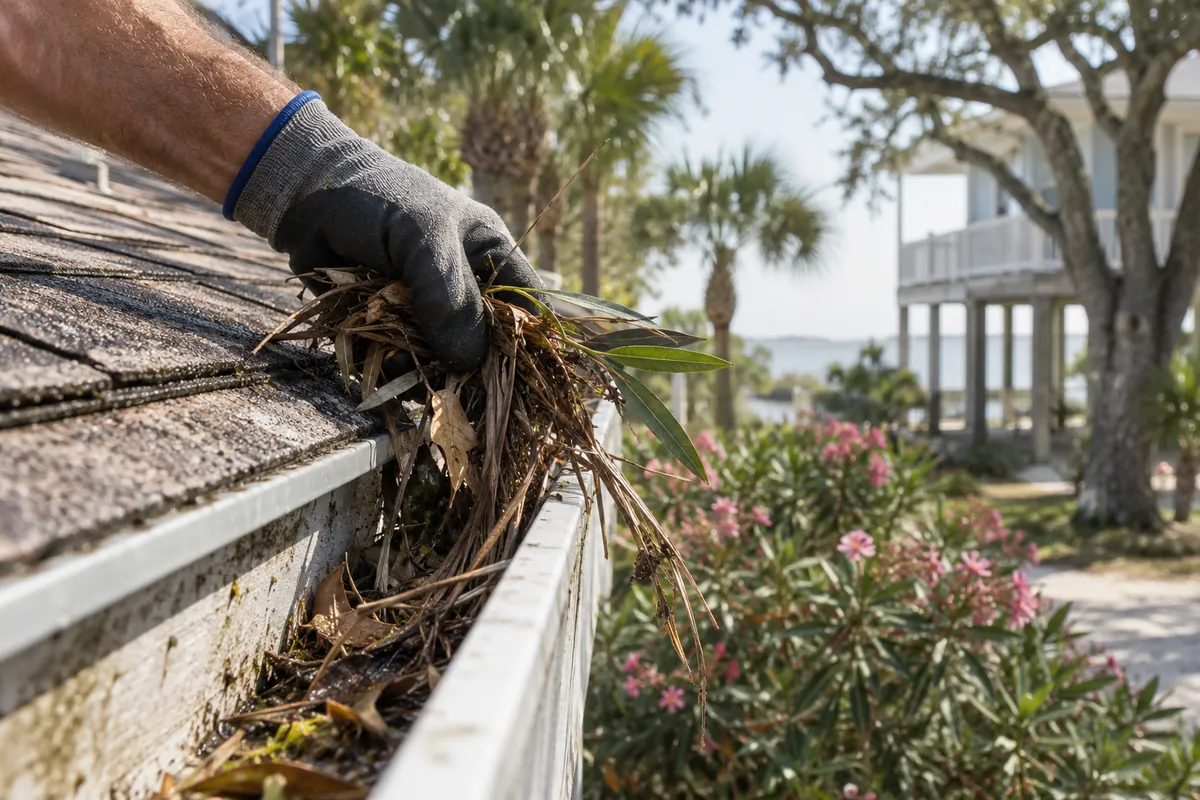
Full-system debris removal and flush testing on elevated structures, clearing salt residue buildup and organic debris. Scheduling available between vacation rental bookings for investment property owners managing West End rentals.
Learn More →Gutter Guards
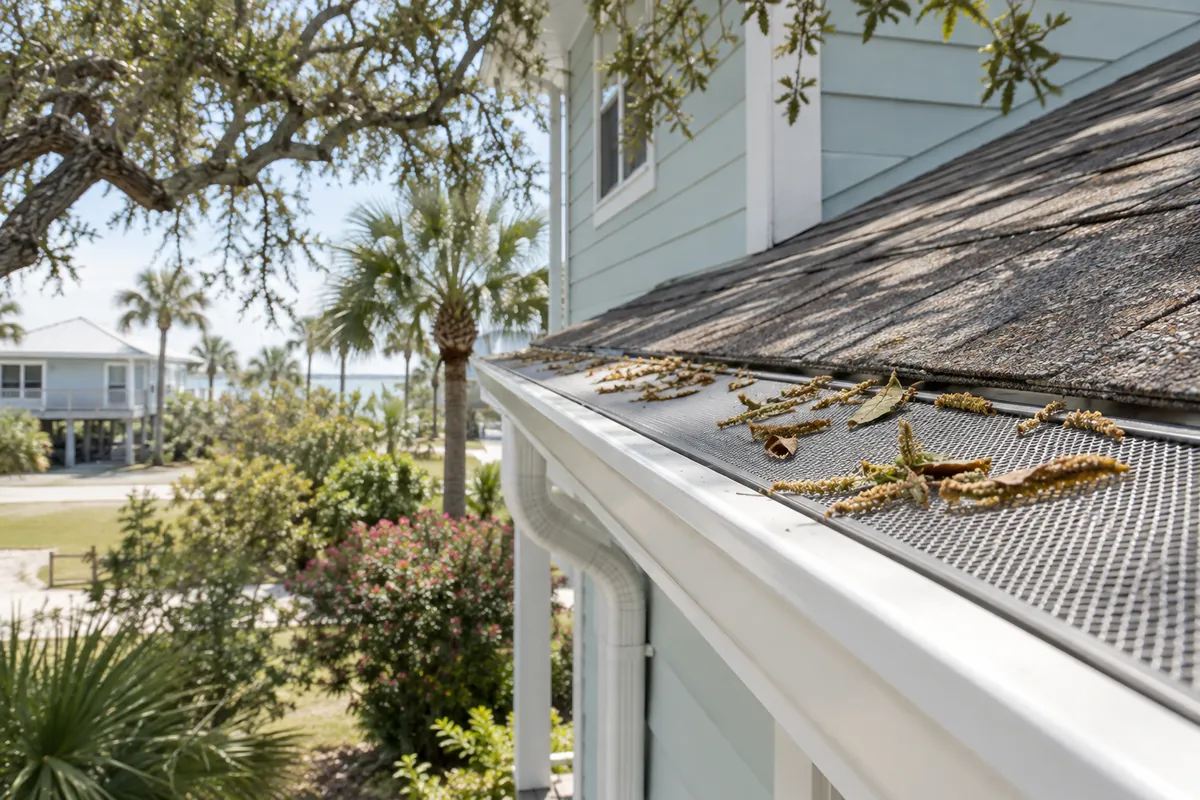
Marine-rated micro-mesh guard systems that reduce cleaning frequency on Jamaica Beach vacation rentals and year-round homes alike, maintaining full water flow during intense Gulf Coast downpours while blocking fine coastal debris.
Learn More →Downspout Services
Extended downspout installations for Jamaica Beach's tall piling construction, including underground French drain connections, splash pads, and erosion-control discharge solutions that protect sandy substrate around piling bases.
Learn More →Questions about gutter systems for elevated homes?
No obligation — free estimates available Monday through Friday, 7AM–9PM.
Maximum Gulf Exposure on the Unprotected West End
Jamaica Beach sits on one of the most exposed stretches of the Texas coast. Unlike the eastern half of Galveston Island, which benefits from the 10-mile Seawall and the wind-breaking mass of downtown's commercial buildings, the West End where Jamaica Beach is located has no engineered coastal protection. The Gulf shoreline is separated from the nearest homes by nothing more than a low line of natural dunes that shift with every major storm. Onshore winds carry salt spray directly into the residential streets, coating every exterior surface with a corrosive film that never fully dissipates between weather events. For gutter systems, this means continuous salt exposure on troughs, downspouts, brackets, and fasteners — a relentless chemical attack that demands materials specified for marine environments rather than standard residential grades.
Jamaica Beach lies squarely in the path of every tropical system that approaches the upper Texas coast. Hurricane Ike's direct hit in 2008 effectively destroyed the pre-existing community, and the rebuilding process took years. More recently, Hurricane Beryl in July 2024 brought destructive winds and heavy rainfall that stressed gutter systems throughout the West End. The post-Ike construction that now characterizes Jamaica Beach was built to withstand these events, but the gutter systems attached to those well-engineered structures must be held to the same standard. Bracket spacing on Jamaica Beach installations should not exceed 18 inches, and every fastener should be a marine-grade stainless steel screw rated for sustained wind loads of 110 miles per hour or greater. The extended downspout runs on elevated homes are particularly vulnerable to wind damage because the long vertical sections act as sails that catch lateral gusts, and inadequate bracketing allows the downspout to pull away from the piling during storm events.
Annual rainfall in Jamaica Beach averages approximately 50 inches, arriving in a pattern that concentrates the heaviest precipitation between June and October. Summer thunderstorms can deliver two or more inches per hour in sudden, intense downpours that overwhelm undersized gutter systems within minutes. The flat topography of the West End — essentially at sea level outside of the man-made elevation of the homes themselves — means there is no natural grade to assist drainage. Water that leaves a downspout at ground level has nowhere to go unless it is actively directed away from the structure through graded channels, French drains, or extension piping. Standing water around piling bases during prolonged rain events is a chronic issue in Jamaica Beach that accelerates erosion of the sandy substrate and can compromise the structural integrity of foundation systems over time.
Ultraviolet radiation on the West End is intense and unrelenting. Without the shade canopy that mature live oaks provide in more established Galveston neighborhoods, Jamaica Beach homes and their gutter systems sit in full sun for most of the day. UV exposure degrades the factory-applied coatings on aluminum gutters, causing fading and chalking that eventually exposes the bare metal beneath. Once that protective coating breaks down, salt air corrosion accelerates dramatically. Gutter systems in Jamaica Beach benefit from the heaviest available factory coatings and, where budget allows, from materials like copper or coated steel that offer inherently greater resistance to the combined UV and salt assault that characterizes this environment. Regular inspection of coating integrity — looking for chalking, peeling, or bare metal exposure — should be part of every annual maintenance visit.
Jamaica Beach Quick Facts
- Gulf exposure: Maximum — no seawall, no commercial wind breaks
- Hurricane path: Direct hit from Ike (2008), Beryl (2024)
- All elevated homes: 14–18 ft piling construction post-Ike
- Annual rainfall: ~50 inches, intense summer thunderstorms
- Salt corrosion: Continuous, unobstructed onshore salt spray
- UV degradation: Full sun exposure, limited tree canopy
- Sandy substrate: Erosion risk at every downspout discharge point
Nearby Service Areas
Galveston Clean Gutters provides professional gutter services across Galveston County and the surrounding mainland communities.
Protect Your Jamaica Beach Home from Gulf Coast Elements
Free estimates and transparent pricing on every gutter project, from routine cleaning to full system installation on elevated West End homes.
Call For Free Estimate