Prairie Wetlands, Serious Water Management
Hitchcock occupies a stretch of low-lying coastal prairie in Galveston County that most people pass through without a second glance. Positioned along Highway 6 between La Marque to the east and Santa Fe to the northwest, this small community of roughly 7,000 residents sits at an elevation that barely registers above sea level—a geographic reality that defines nearly every aspect of property maintenance within the city limits. The Hitchcock Prairie Preserve, one of the last remaining native coastal prairies in Texas, lies just outside town, and its presence speaks directly to the kind of terrain that extends beneath every home, business, and roadway in the area: flat, saturated grassland with a water table that rarely drops far below the surface.
Unlike neighboring communities that contend with bayou flooding as their primary water challenge, Hitchcock faces a different problem. No significant bayou runs through the heart of town to create a concentrated flood corridor. Instead, the challenge is diffuse and persistent—water accumulates everywhere, slowly, across terrain that offers virtually no natural slope to encourage drainage. After a heavy rain event, the landscape around Hitchcock does not flood so much as it simply fills. Low spots in yards become temporary ponds. Ditches along FM 2004 and the smaller county roads rise to their banks and hold that level for days. The water table, already high under normal conditions, pushes even closer to the surface, leaving soil saturated to a degree that prevents any meaningful absorption of additional rainfall.
The High Water Table Problem
For homeowners in Hitchcock, the high water table creates a compounding drainage equation that differs meaningfully from what properties face in cities with better natural grade. In communities with even modest topography, roof runoff captured by gutters and discharged through downspouts has somewhere to go—gravity pulls it downhill, away from the foundation, toward a street drain or a natural low point in the landscape. In Hitchcock, that luxury does not exist. Downspout discharge hits ground that is already saturated, spreads laterally rather than draining downward, and often migrates back toward the very foundation it was supposed to protect. This is why downspout management in Hitchcock is not an afterthought but rather the most critical component of any gutter system installation or upgrade.
The flat terrain also means that gutter pitch—the slight slope built into every gutter run to direct water toward the downspouts—must be precise. In hillier areas, a gutter installer has some margin for error because the overall slope of the roofline provides a natural assist. On the low-pitch and shallow-angle roofs common in Hitchcock, that assist disappears. A gutter run that is even slightly off-pitch will hold standing water, accumulate debris more quickly, and develop the kind of persistent moisture that accelerates corrosion and creates ideal conditions for mosquito breeding—an issue that Hitchcock residents are already well acquainted with, given the surrounding wetlands.
Older Housing Stock, Real Consequences
Much of Hitchcock's residential construction dates to the 1950s, 1960s, and 1970s, an era when the community served as affordable housing for workers in the nearby industrial corridor stretching south through Texas City. These homes were built modestly—frame construction on pier-and-beam or slab foundations, simple gable rooflines, and in many cases no gutter system at all. The builders of that era relied on wide roof overhangs and basic lot grading to move water away from structures, an approach that worked adequately when the homes were new and the surrounding drainage infrastructure was recently constructed. Decades later, many of those lots have settled, drainage ditches have silted in, and the original grading has been compromised by additions, tree root systems, and the slow subsidence that affects all low-lying Gulf Coast communities.
Hitchcock sits on flat coastal prairie with a persistently high water table. Roof runoff that reaches saturated ground has nowhere to drain, making properly sized gutters and engineered downspout discharge the only controllable line of defense between a home and chronic moisture damage.
For these older homes, a first-time gutter installation is often the single most impactful improvement a new owner can make. The cost is modest relative to the foundation repair bills that accumulate when decades of uncontrolled roof runoff pour directly against pier footings or slab edges. And for homes that do have original gutters—typically galvanized steel sectional systems with slip-joint connectors—full replacement with seamless aluminum is almost always more cost-effective than attempting to patch sixty-year-old metal that has corroded at every seam, hanger point, and end cap.
Hitchcock does not generate headlines the way island communities do during hurricane season, and it does not attract the development investment flowing into League City or Friendswood to the north. But the water management challenges here are as demanding as anywhere in Galveston County, and the homes that weather those challenges best are invariably the ones with gutter systems designed for the actual conditions of this quiet prairie community rather than for some generic standard that ignores the realities on the ground.
Property Landscape
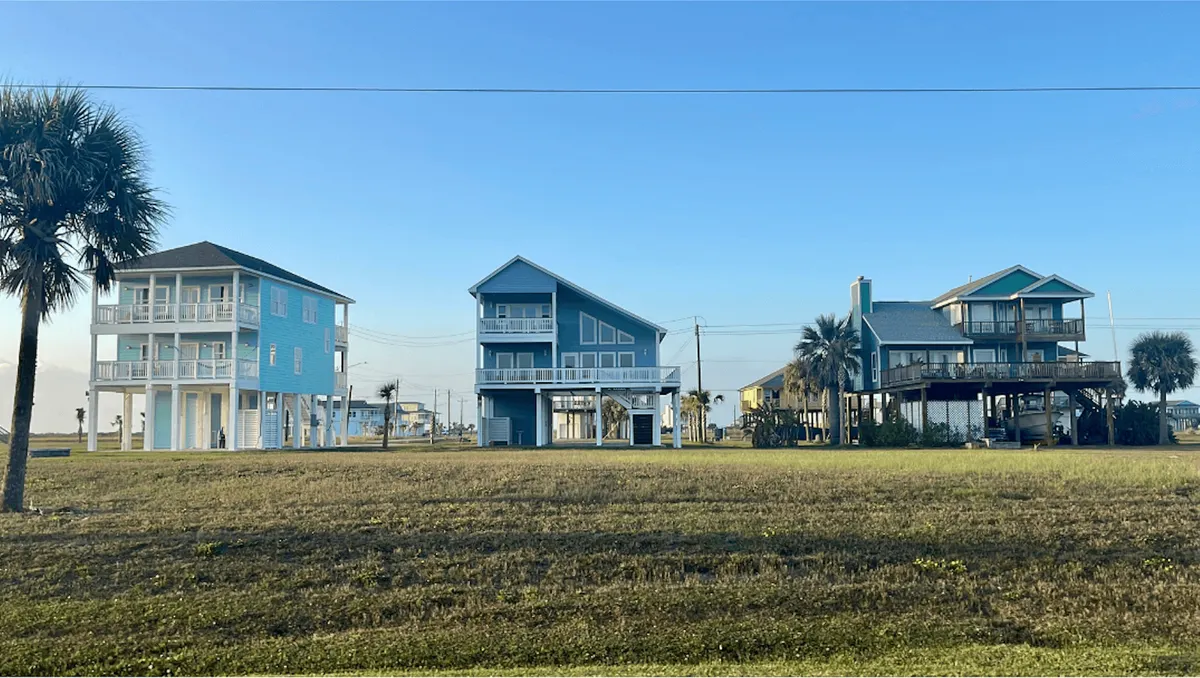
Hitchcock's residential character reflects a community that grew steadily during the mid-twentieth century, plateaued as the broader Galveston County economy shifted, and has remained relatively stable in the decades since. The result is a housing stock that skews older and more affordable than the county average, with a small-town atmosphere that attracts homeowners looking for space and quiet rather than new construction and amenities. Each segment of Hitchcock's property landscape presents specific considerations for gutter contractors and homeowners planning drainage improvements.
In-Town Frame and Brick Homes
The core of Hitchcock's residential areas runs along and between Highway 6 and the parallel streets that branch off toward FM 2004 to the south. Here, compact lots hold single-story frame homes and brick ranch houses built between the 1950s and 1970s. Frame construction predominates on the older lots closer to the center of town—clapboard siding, composition shingle roofs with simple gable profiles, and pier-and-beam foundations that have settled unevenly over the decades. Many of these homes feature mature trees—live oaks, pecans, and an occasional Chinese tallow—that overhang roof edges and deposit significant volumes of leaves, catkins, and small branches into any gutter system installed beneath them.
Brick ranch homes appear more frequently along the streets developed during the 1960s and 1970s, typically featuring hip rooflines that distribute water to all four sides of the structure. These roofs require full-perimeter gutter coverage rather than the eave-only approach that works on simple gable homes. The hip-roof geometry also creates valley collection points where two roof planes meet, concentrating water flow in ways that can overwhelm standard 5-inch gutters during high-intensity downpours. A 6-inch gutter at valley discharge points, stepping down to 5-inch on standard runs, is a practical sizing approach for these homes.
Rural Acreage on the Outskirts
Hitchcock transitions quickly from small-town residential to rural acreage on its northern and western edges, where larger parcels of one to five acres hold a mix of older farmhouses, manufactured homes, and occasional newer custom builds. These properties face a different set of gutter challenges. The homes themselves are often set back from the road with long driveways, and the surrounding terrain is open prairie that provides no tree canopy to slow wind-driven rain. During Gulf Coast thunderstorms, wind-driven rain can push water sideways under gutter edges and against fascia boards at angles that standard gutter profiles are not designed to capture. Wider gutter profiles and properly installed drip edges become important on these exposed properties.
The acreage properties also tend to rely on individual drainage solutions rather than municipal storm infrastructure. Roof runoff discharged by downspouts needs to be directed into drainage swales, dry creek beds, or underground pipe systems that carry water well away from the foundation—distances of twenty to thirty feet or more in many cases, given the flat terrain and the absence of any natural grade to assist with surface flow.
Highway 6 and FM 2004 Corridor
The commercial and mixed-use properties along Highway 6 and FM 2004 include small retail buildings, churches, and a handful of light-commercial structures that were built to mid-century standards and have been adapted over the decades. These buildings often have flat or very low-slope roof sections that require specialized commercial gutter profiles and box-style downspouts to handle the volume of water collected across their broad roof surfaces. Property owners along these corridors face the additional challenge of coordinating their drainage discharge with the TXDOT right-of-way drainage system—a system that, during heavy rain events, is often already running at or beyond capacity.
Gutter Services for Hitchcock Homes
Every service addresses the high water table, flat prairie terrain, and aging housing stock that define property maintenance in Hitchcock.
Gutter Installation
Seamless aluminum systems designed for Hitchcock's mid-century rooflines. First-time installations on older homes that never had gutters, plus full-perimeter coverage for hip-roof brick ranches with precise pitch calibration for flat-terrain performance.
Learn More →Gutter Repair
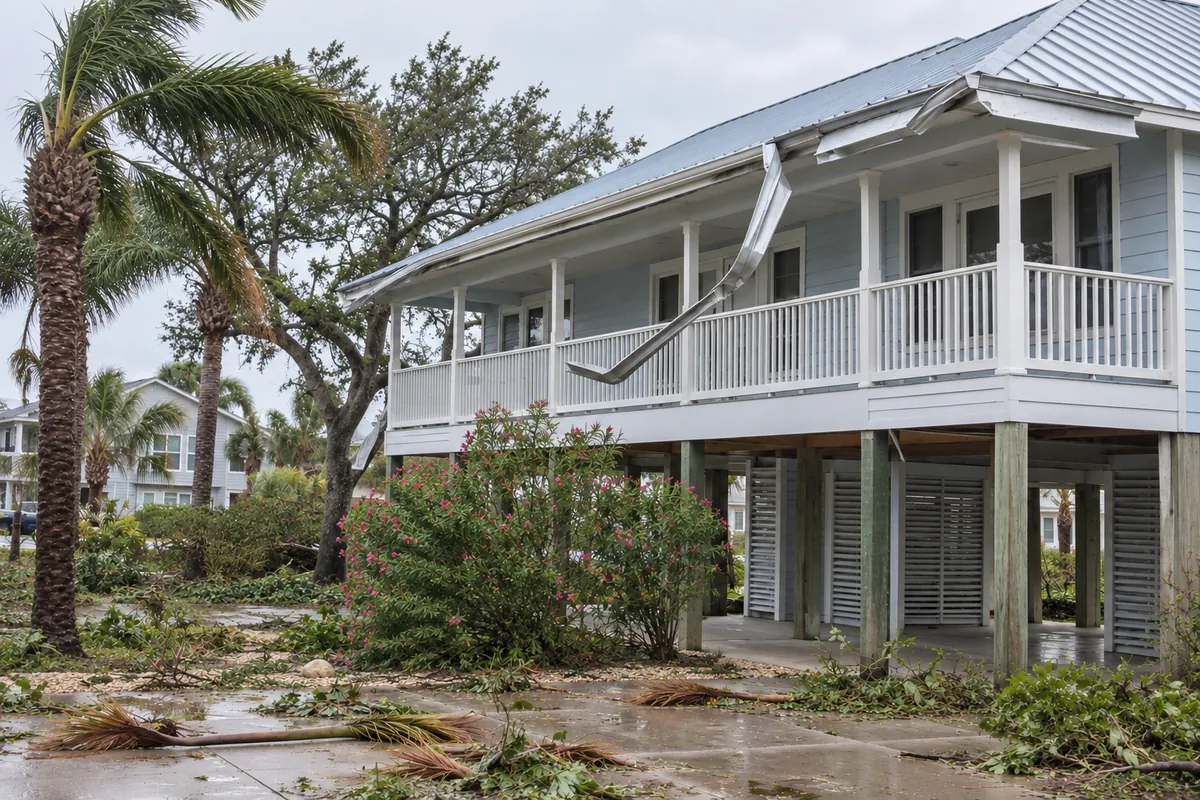
Targeted fixes for corroded joints on aging sectional gutters, sagging runs from failed hangers, and storm-damaged sections. Re-pitching services for gutter runs that have settled on Hitchcock's shifting prairie soils and now hold standing water.
Learn More →Gutter Cleaning
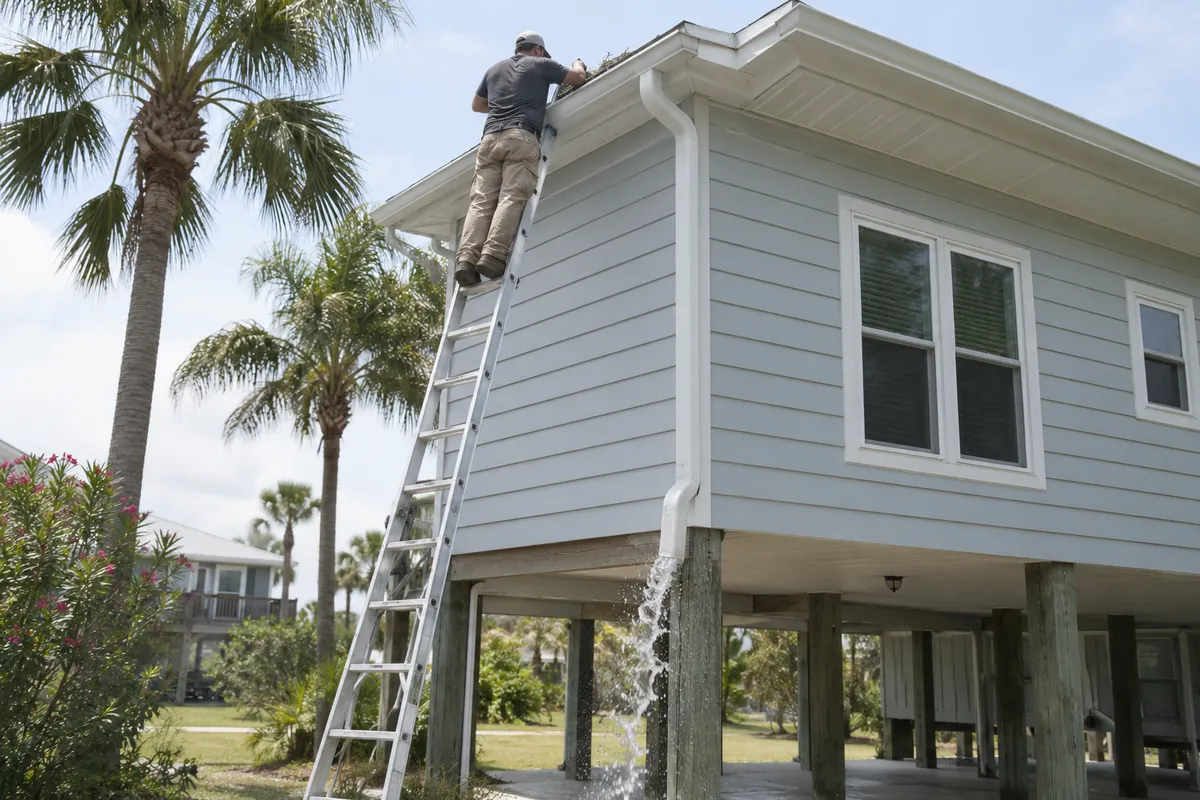
Seasonal cleaning built around Hitchcock's live oak and pecan canopy—spring catkin drops, fall leaf shed, and post-storm debris removal. Includes downspout flushing and a full visual inspection to catch standing-water issues early.
Learn More →Gutter Guards
Micro-mesh guard systems that block prairie debris, live oak leaves, and pecan husks while maintaining full flow capacity during intense downpours. Especially valuable for Hitchcock homes surrounded by mature tree canopy that demands constant cleanings.
Learn More →Downspout Services
The most critical service for Hitchcock's flat terrain and high water table. Extensions, underground drain tie-ins, and pop-up emitters engineered to move water twenty feet or more from foundations on lots where saturated soil provides zero natural drainage.
Learn More →Ready to Protect Your Hitchcock Property?
Free estimates with transparent pricing—no pressure, no hidden fees.
Why Hitchcock Gutters Work Harder
Fifty inches of annual rainfall, a persistently high water table, flat prairie terrain, and surrounding wetlands create some of the most demanding drainage conditions in Galveston County.
Hitchcock receives approximately 50 inches of rainfall annually, with the most intense concentrations arriving between May and October when Gulf Coast thunderstorms routinely deliver two to four inches in a single afternoon. On terrain with meaningful topography, that kind of rainfall is manageable—gravity moves water downhill, storm drains collect it, and the system recovers between events. On Hitchcock's flat coastal prairie, the math works differently. Water does not flow away from structures; it spreads across the landscape in a slow, shallow sheet, accumulating in every low spot and pressing against every foundation it encounters.
The high water table amplifies this effect in ways that are difficult to appreciate until a homeowner watches roof runoff pool against a foundation wall during a storm and remain there for days afterward. Under normal conditions, water discharged by downspouts would percolate into the soil and gradually migrate toward the nearest drainage ditch or swale. When the water table is already near the surface—as it commonly is in Hitchcock, particularly during the wet months from May through October—that percolation slows to a crawl. The soil is already holding as much water as it can. Additional water from downspout discharge simply sits on the surface, saturating the clay-heavy subsoil that underlies most of the community and exerting lateral pressure against foundation walls and pier footings.
The proximity to the Hitchcock Prairie Preserve and the broader wetlands system that extends toward the coast means that the land surrounding the community functions as a natural water-retention basin. During extended rain events, the water that collects in these wetlands has nowhere to drain quickly, and the elevated groundwater levels extend into the residential areas of town. This is not a flood event in the traditional sense—there is no bayou cresting its banks or surge pushing inland. It is simply the landscape doing what flat, low-lying prairie does when it receives more rain than it can process: holding the water in place until evaporation and slow subsurface drainage eventually return levels to normal.
Moderate humidity throughout the year—rarely dropping below 60 percent and frequently exceeding 85 percent during summer months—creates additional stress on gutter systems. Metal components that remain damp for extended periods develop surface corrosion more quickly than identical systems in drier climates. Hidden hangers and internal bracket hardware are particularly vulnerable because they sit in the moisture-trapping zone where the back of the gutter meets the fascia board. Marine-grade fasteners and painted aluminum rather than bare metal components extend service life meaningfully in this environment.
Hitchcock Quick Facts
- Annual Rainfall: ~50 inches, concentrated May–October
- Water Table: Persistently high; near-surface during wet months
- Terrain: Flat coastal prairie; virtually zero natural drainage grade
- Wetlands Proximity: Hitchcock Prairie Preserve adjacent to community
- Soil Type: Clay-heavy subgrade; slow percolation, expansion risk
- Humidity: Moderate to high year-round; 60–85%+ in summer
- Peak Storm Season: June through November
- Key Drainage Challenge: No central bayou; diffuse water accumulation
Nearby Communities Also Served
Galveston Clean Gutters serves Hitchcock and neighboring communities throughout Galveston County.
Protect Your Hitchcock Home from Water Damage
Flat prairie terrain, a high water table, and fifty inches of annual rain demand gutter systems built for the real conditions of this community. Connect with a qualified contractor today.
(409) 741-9557