Rural Character, Serious Drainage
Santa Fe occupies the rural interior of Galveston County, a community of roughly 13,000 residents spread across a landscape that feels more like East Texas ranch country than the coastal suburbia found just a few miles to the east. Situated along Highway 6 between Hitchcock and League City, the city and its surrounding unincorporated areas are defined by something increasingly rare in the Houston metro—space. Lots of one to five acres are common, ten-acre parcels are not unusual, and the character of the land shifts from pine-dotted pasture to fenced horse paddocks to hay fields within a few miles of the city center.
That rural footprint shapes the gutter conversation in ways that distinguish Santa Fe from every other community Galveston Clean Gutters serves. Homes here tend to be larger than the county median, with sprawling single-story ranch plans, wraparound porches, and attached multi-car garages that push total roof area well beyond what typical suburban homes generate. A 3,200-square-foot home on a slab foundation with a covered front porch, a rear patio extension, and a porte-cochere can easily present 4,000 or more square feet of roof surface draining into gutter systems. That additional linear footage changes the math on material quantities, downspout placement, and total project cost in meaningful ways.
No Municipal Storm Drainage
The single most important factor separating Santa Fe from communities like League City or Friendswood is the absence of municipal storm drainage infrastructure in the unincorporated areas. There are no storm sewers running beneath the roads, no concrete-lined drainage channels carrying water to retention ponds, and no city-maintained culverts managing flow from lot to lot. In practical terms, this means every property is responsible for managing its own stormwater. Whatever falls on the roof must be captured, channeled, and discharged in a way that prevents foundation damage, erosion, and standing water—all without the safety net of public drainage systems backing up the effort.
This reality elevates gutter systems from a nice-to-have feature to a load-bearing component of property management. On a five-acre horse property where the home sits 200 feet from the nearest county road ditch, an undersized or clogged gutter system does not just create a puddle by the front door. It allows water to saturate the soil around the foundation slab, accelerating the expansion and contraction cycles in the region's clay-heavy soils that cause foundations to shift, crack, and settle unevenly over time. The cost of repairing a slab foundation in this part of Texas routinely runs into five figures—a problem that properly sized gutters and well-planned downspout discharge can prevent entirely.
Agricultural Properties and Outbuildings
Santa Fe's agricultural identity introduces another layer of gutter demand that suburban communities simply do not generate. Horse barns, hay storage buildings, equipment sheds, and detached workshops are standard features on properties throughout the area. Many of these structures were built without any gutter system at all, allowing roof runoff to sheet off metal roofing panels directly onto the ground below. Over years, this uncontrolled discharge creates erosion trenches along the drip line, undermines gravel pads and barn aprons, and turns the areas around barn entrances into mud pits during the wet season.
Properties in Santa Fe's unincorporated areas operate without municipal storm drainage. Every gutter system is the first and last line of defense against foundation damage, erosion, and standing water—there is no public infrastructure backing up the effort.
Retrofitting gutters onto agricultural buildings requires a different approach than residential work. Metal-roofed barns often lack conventional fascia boards, requiring specialized mounting brackets that attach directly to the roof edge or purlins. The pitch on many agricultural buildings is steeper than residential rooflines, which means water enters the gutter trough at higher velocity and volume, demanding 6-inch or even commercial-grade 7-inch gutters to prevent overtopping during heavy rainfall. Downspout discharge on agricultural properties must also account for livestock traffic patterns, equipment access lanes, and the location of paddock fencing—factors that a residential gutter installation would never need to consider.
The combination of large residential roof footprints, absent municipal drainage, and outbuilding inventory creates a per-property gutter demand in Santa Fe that is among the highest in Galveston County. A single property may require 300 to 500 linear feet of gutter across the main home, a detached garage, and a barn—compared to 120 to 180 feet for a typical suburban home in League City or Friendswood. That volume makes material selection, installation quality, and long-term maintenance planning especially consequential.
Property Landscape
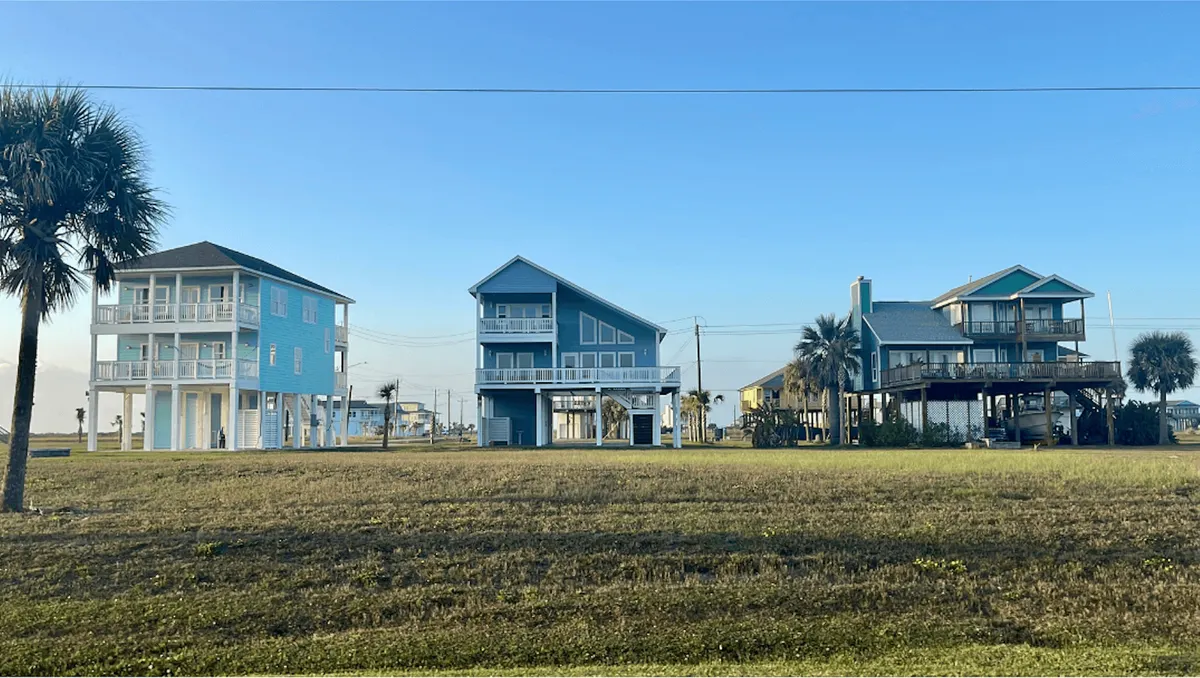
Santa Fe's housing stock defies easy categorization. Unlike master-planned communities where every home falls within a narrow band of size, age, and style, the properties here span a wide spectrum—from manufactured homes on rural lots to custom-built brick ranches on five-acre parcels, with a growing number of newer subdivision homes filling in the gaps between the older homesteads.
Manufactured and Modular Homes
A significant portion of Santa Fe's housing inventory consists of manufactured and modular homes, many placed on permanent foundations across larger rural lots. These homes present a specific set of gutter challenges. Original manufacturer-installed gutters, when present at all, are typically lightweight aluminum sections joined with slip connectors that fail within a few years under the stress of thermal expansion and contraction in the Texas climate. The roof edges on manufactured homes also tend to have narrower fascia boards—sometimes as little as two inches—that require specialized low-profile mounting hardware rather than the standard hidden hangers used on stick-built homes.
For manufactured homeowners in Santa Fe, replacing the factory gutter system with seamless aluminum installed using appropriately sized brackets often represents the most cost-effective improvement available for long-term property protection. The absence of joints in a seamless system eliminates the primary failure point, and proper pitch adjustment during installation ensures that water moves efficiently toward downspouts rather than pooling at low points where debris accumulates.
Custom Ranches and Acreage Homes
The signature Santa Fe property is the custom-built ranch home on one to five acres. These homes were typically constructed between the 1980s and early 2000s, often by local builders working from owner-modified plans. Roof designs on these homes tend toward complexity—multiple hip sections, covered porches that wrap two or more sides of the structure, attached carports or porte-cocheres, and rear patio covers that were added after original construction. Each of these elements creates additional roof planes that need gutter coverage, and the intersections between original and added-on sections are frequent sources of leaks and improper drainage.
Many of these custom homes were also built with oversized soffits and deep fascia that accommodate standard gutter installation without issue, but the sheer length of continuous runs along ranch-style facades introduces its own challenge. A single uninterrupted run of 60 feet or more requires careful pitch calculation and often benefits from a center-feed downspout configuration rather than the standard end-feed approach, which can leave the far end of the run collecting standing water during moderate rainfall events.
Newer Subdivisions
The past decade has brought conventional subdivision development to areas along FM 646 and Highway 6, introducing two-story homes with smaller lot sizes that look more like the housing stock in Dickinson or League City. These homes arrive with builder-installed gutter systems that face the same issues found throughout the region—undersized 5-inch gutters on roofs that generate enough volume to overwhelm them, and downspout placement dictated by aesthetic symmetry rather than actual drainage volume. For homeowners in these newer developments, the most common upgrade involves adding downspouts at high-volume collection points and extending discharge lines farther from foundations to prevent the soil saturation that causes slab movement.
Across every property type in Santa Fe, the rural context means that gutter contractors must plan for longer downspout runs, more complex discharge routing, and the possibility that the nearest appropriate drainage point—a ditch, swale, or low area—may be 30, 50, or even 100 feet from the structure. Underground drain lines with pop-up emitters are increasingly common on Santa Fe properties, allowing water to be moved well away from foundations and building pads without creating surface-level trip hazards or interfering with mowing patterns on large lawns.

Gutter Services for Santa Fe Properties
Every service is tailored to the large-lot, rural-property, and self-managed drainage realities specific to Santa Fe and its surrounding unincorporated areas.
Gutter Installation
Seamless aluminum systems sized for Santa Fe's oversized roof footprints. Custom solutions for ranch homes, manufactured homes with narrow fascia, and agricultural outbuildings requiring specialized mounting brackets.
Learn More →Gutter Repair
Targeted fixes for sagging sections on long ranch-style runs, failed slip connectors on manufactured home systems, and storm damage from fallen pine limbs. Re-pitching and hanger re-spacing for aging installations.
Learn More →Gutter Cleaning
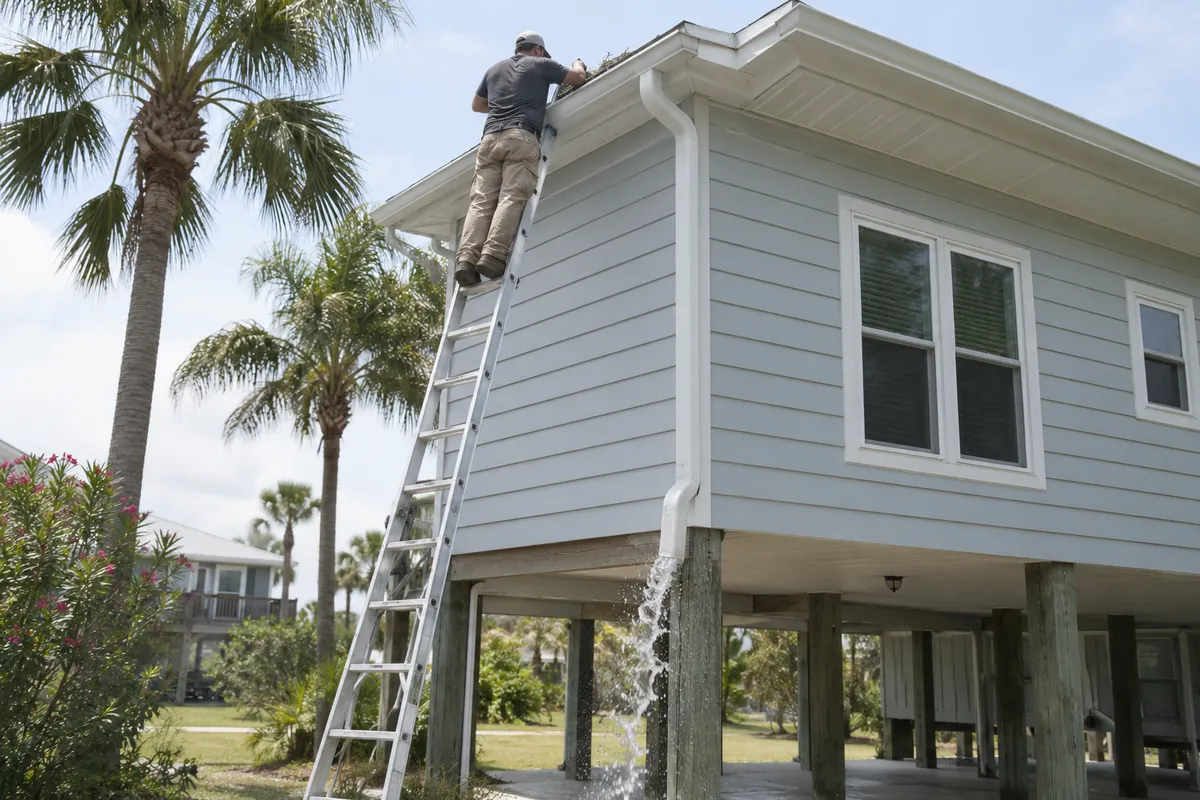
Multi-structure cleaning covering homes, barns, and workshops in a single visit. Pine needle and oak leaf removal on a seasonal schedule calibrated to Santa Fe's heavy rural tree canopy.
Learn More →Gutter Guards
Micro-mesh systems that handle the heavy pine needle and leaf load from Santa Fe's dense rural canopy. Especially effective on properties where roof access for cleaning is limited by building height or terrain.
Learn More →Downspout Services
Extended discharge planning for rural lots where the nearest drainage point may be 50 to 100 feet from the structure. Underground drain lines with pop-up emitters move water away from foundations without disrupting mowing patterns.
Learn More →Ready to Protect Your Santa Fe Property?
Free estimates for homes, barns, and outbuildings—no pressure, no hidden fees.
Why Santa Fe Gutters Work Harder
Fifty inches of annual rainfall, no municipal drainage, flat terrain over clay-and-sand soil, and a heavy rural tree canopy create conditions where gutter performance is not optional—it is the only thing standing between a property and water damage.
Santa Fe receives approximately 50 inches of rainfall annually, distributed in a pattern that mirrors the broader Gulf Coast cycle: relatively dry winters giving way to increasingly wet conditions from April through October, with the heaviest downpours arriving during the tropical storm season between June and November. Individual thunderstorm cells routinely deliver two to three inches in under an hour during the summer months, generating roof runoff volumes that would challenge even a properly maintained gutter system—and overwhelm any system that is undersized, improperly pitched, or partially clogged with debris.
The absence of municipal storm drainage infrastructure in unincorporated Santa Fe means there is no backup system to compensate when gutters fail. In a suburban community with storm sewers, an overflowing gutter deposits water onto the ground where it eventually finds its way to a street drain. In rural Santa Fe, that water has nowhere to go. It pools against the foundation, saturates the soil around the slab perimeter, and begins the slow process of undermining the stability of the structure. The region's soil profile—a layer of clay over sandy subgrade—makes this particularly damaging. Clay soils expand when wet and contract when dry, creating cyclical pressure against foundations that causes cracking and settlement over time. Properties where gutter discharge is not routed well away from the foundation experience this cycle at an accelerated rate.
The flat terrain that characterizes most of Santa Fe compounds the drainage challenge. Without meaningful natural grade to direct surface water away from structures, the downspout discharge point must be carefully planned. On many rural lots, this means running underground drain lines 30 to 50 feet or more to reach a roadside ditch, a swale, or a low area of the property where water can be safely deposited without creating standing water problems for neighboring parcels. Pop-up emitters at the terminus of these underground lines allow water to surface and dissipate without creating permanent soggy spots in lawns or pasture areas.
Santa Fe's rural tree canopy introduces the final and most persistent maintenance variable. Loblolly pines, live oaks, water oaks, and various hardwoods grow densely on many properties, dropping needles, leaves, catkins, and small branches into gutters on a nearly continuous basis from late winter through early fall. Pine needles are especially problematic because their shape allows them to interlock within the gutter trough, forming a mat that traps additional debris and creates dams that block water flow even when the gutter appears only partially filled. Properties with significant pine canopy typically require three cleanings per year—late winter after the heaviest needle drop, mid-summer to clear spring oak catkins and early debris, and late fall to remove the final leaf accumulation before the wet winter months.
Santa Fe Quick Facts
- Annual Rainfall: ~50 inches, concentrated May–October
- Municipal Drainage: None in unincorporated areas
- Terrain: Flat; no natural grade for water movement
- Soil Type: Clay over sand; high expansion/contraction risk
- Tree Canopy: Dense pines, live oaks, water oaks
- Typical Lot Size: 1–5 acres; some 10+ acres
- Peak Storm Season: June through November
- Cleaning Frequency: 3x/year recommended (heavy canopy)
Nearby Communities Also Served
Galveston Clean Gutters serves Santa Fe and neighboring communities throughout Galveston County.
Protect Your Santa Fe Property from Water Damage
Large lots, no municipal drainage, and fifty inches of rain demand gutter systems built for the real conditions of rural Galveston County. Connect with a qualified contractor today.
(409) 741-9557