Salt Air Changes the Equation for Every Gutter System
Homes on Galveston Island sit within a constant salt aerosol zone. Wind carries microscopic salt particles from the Gulf inland, and those particles settle on every exterior surface — including gutters, hangers, and fasteners. Over time, this salt exposure accelerates corrosion on materials that perform perfectly well in landlocked cities but deteriorate rapidly near the coast.
Material selection is the single most important decision in a Galveston gutter installation. Standard galvanized steel, a common and affordable choice in central Texas, begins showing rust within three to five years on island properties. The zinc coating simply cannot withstand constant salt bombardment. Painted seamless aluminum offers a significant step up, providing a 20- to 30-year lifespan when properly maintained with periodic freshwater rinsing. Galvalume — an alloy coating of 55% aluminum, 43.4% zinc, and 1.6% silicon — was engineered specifically for coastal and industrial environments and remains the top recommendation for homeowners seeking the best balance of longevity and cost. Copper, while carrying the highest upfront price, develops a protective verdigris patina that makes it essentially immune to salt corrosion and can last well beyond 50 years.
The neighborhoods of the East End Historic District and the Silk Stocking District present a particular consideration. Many of these Victorian-era and early 20th-century homes feature ornamental trim and custom fascia profiles that require careful integration with modern gutter systems. Half-round copper gutters are a popular choice in these areas, complementing the architectural character while offering unmatched coastal durability. The Galveston Historical Foundation provides guidelines on exterior modifications for homes in locally designated historic districts.
Engineered for Elevated Homes and Hurricane Conditions
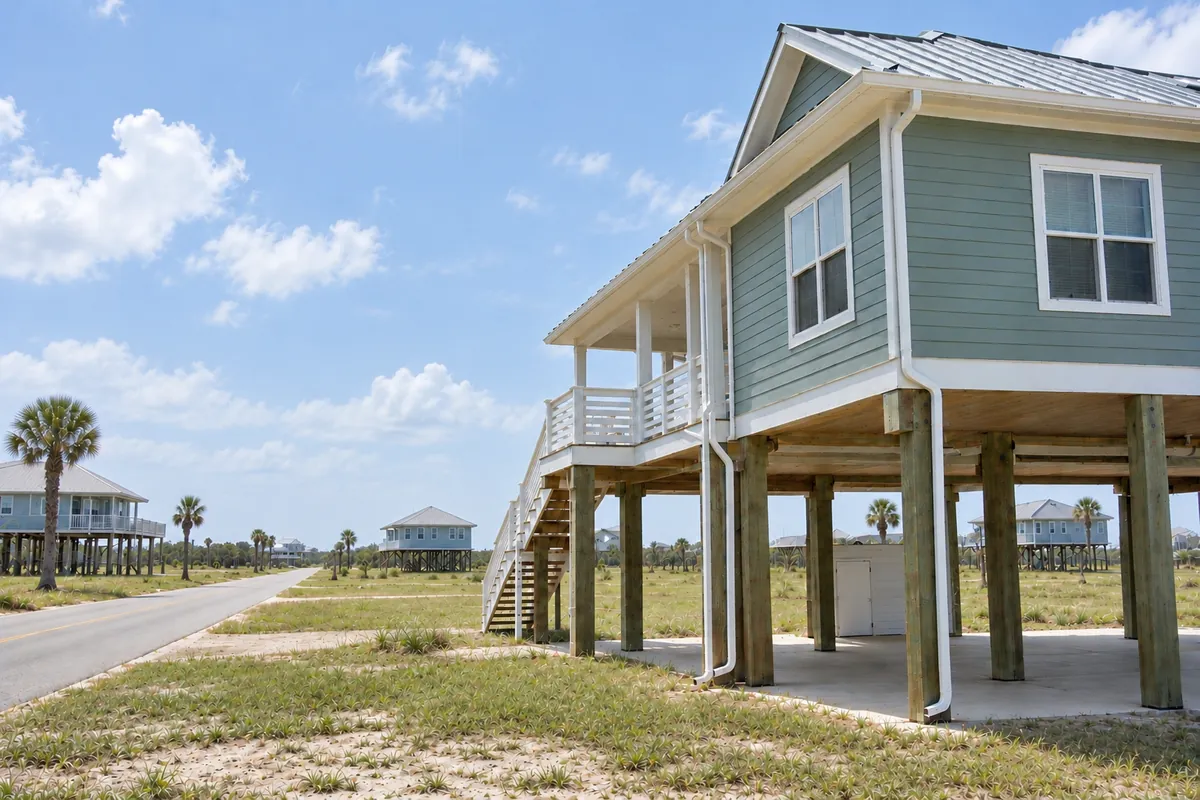
A large portion of Galveston's residential inventory sits on pier-and-beam foundations — a construction method that elevates homes anywhere from two to fourteen feet above grade. While this elevation protects against storm surge, it also means that downspout routing requires more planning than on slab-on-grade homes common elsewhere in the Houston metro. Extended downspouts must carry water from the elevated gutter line all the way to grade level and direct it away from the pier supports, where water pooling can undermine the foundation over time.
Hurricane-rated hanger spacing is another critical distinction for coastal installations. In non-coastal regions, gutter hangers are typically spaced every 36 inches. On Galveston Island and Bolivar Peninsula, where sustained tropical storm winds regularly exceed 75 mph, hangers should be spaced every 18 to 24 inches. This tighter interval prevents the gutter from pulling away from the fascia during high-wind events — a common failure mode observed after Hurricane Ike in 2008 and more recently after Hurricane Beryl in 2024. Hidden hangers fastened with structural screws driven directly into rafter tails, rather than through fascia board alone, provide the strongest hold.
The Texas Windstorm Insurance Association (TWIA) provides wind-resistant construction guidelines for coastal properties. While TWIA standards focus primarily on roofing and structural components, a properly installed gutter system that meets or exceeds these fastening standards contributes to the overall wind resistance of the roofline assembly. Homeowners carrying TWIA policies should ensure their gutter installation documentation is maintained alongside other wind-mitigation records.
According to NWS Houston/Galveston, the Galveston area receives over 50 inches of precipitation in a typical year, with peak rainfall concentrated between June and October. A single tropical system can deliver 8 to 15 inches in a 24-hour period. Gutters that are undersized, improperly pitched, or fastened with standard inland spacing are overwhelmed during exactly the weather events when they matter most. Proper installation — the right material, the right size, and the right hanger engineering — is the foundation that every other gutter service builds upon.
Pricing Guide
Galveston Gutter Installation Costs
Cost ranges reflect material, home complexity, and the coastal-grade fastening and fabrication standards required for island properties.
| Gutter Type | Price Per Linear Foot | Best For | Coastal Lifespan |
|---|---|---|---|
| Seamless Aluminum 5" | $8 – $12/LF | Standard residential, smaller rooflines | 20 – 30 years |
| Seamless Aluminum 6" | $10 – $15/LF | High-volume rainfall, larger homes | 20 – 30 years |
| Galvalume Steel | $10 – $18/LF | Maximum salt air resistance on a budget | 30 – 50 years |
| Copper | $25 – $45/LF | Historic homes, premium applications | 50+ years |
| Half-Round (Aluminum or Copper) | $12 – $25/LF | Architectural style, historic districts | 20 – 50+ years |
| Standard Galvanized Steel | $6 – $9/LF | Not recommended for island properties | 3 – 7 years |
Galveston coastal installations typically carry a 10–20% premium over mainland pricing due to marine-grade fasteners, tighter hanger spacing, and corrosion-resistant material requirements.
Homeowners comparing quotes can find a full cost breakdown by material and home size in the Galveston gutter cost guide.
Ready to Protect Your Coastal Home?
Every estimate includes a free fascia inspection and custom material recommendation for the property's specific salt exposure level.
(409) 741-9557 Schedule a Free EstimateMaterial Options
Gutter Materials for Coastal Conditions
Not every gutter material belongs on a saltwater island. The following options are evaluated specifically for performance in Galveston's coastal environment.
Seamless Aluminum
The most widely installed gutter material in the Galveston area. Seamless aluminum resists rust, handles the humidity well, and comes in a wide range of colors to match any exterior. Available in both 5-inch and 6-inch profiles, aluminum gutters are fabricated on-site from continuous coil stock, eliminating the leak-prone seams found in sectional systems.
Coastal note: Periodic freshwater rinsing (2–3 times per year) removes salt deposits and extends the factory-applied finish life significantly. Aluminum does not rust, but salt accumulation can cause pitting over time if neglected.
Galvalume Steel
Galvalume combines the structural strength of steel with a coating engineered for harsh environments. The aluminum-zinc-silicon alloy coating provides barrier protection and galvanic protection simultaneously, making Galvalume the top-performing ferrous gutter material for salt air exposure. It holds up in the same conditions that destroy standard galvanized steel in just a few years.
Coastal note: Galvalume carries the best cost-to-lifespan ratio for island properties. A Galvalume system installed with stainless steel fasteners is one of the most durable and cost-effective configurations available for the upper Texas coast.
Copper
Copper gutters develop a natural patina over time that protects the underlying metal from further corrosion — including salt air corrosion. The distinctive green patina is a hallmark of historic Galveston architecture, particularly in the East End Historic District. Beyond aesthetics, copper requires virtually no maintenance and carries the longest functional lifespan of any gutter material.
Coastal note: Copper is the only gutter material that actually improves its corrosion resistance over time. The patina layer acts as a self-healing barrier. It is the preferred choice for properties where longevity and architectural character outweigh upfront cost considerations.
Half-Round
Half-round gutters feature a U-shaped profile that complements Mediterranean, Spanish Colonial, and Victorian architectural styles — all well-represented in Galveston's historic neighborhoods. Available in both aluminum and copper, half-round systems use external bracket hangers rather than internal hidden hangers. The open trough profile also sheds live oak catkins and oleander debris more readily than K-style gutters.
Coastal note: Half-round copper is the standard recommendation for homes in Galveston's locally designated historic districts. The combination of period-appropriate aesthetics and superior coastal durability makes it a natural fit for preservation-minded homeowners.
Standard Galvanized Steel
Standard galvanized steel relies on a zinc-only coating for corrosion protection. In inland environments, this coating provides adequate protection for 15 to 20 years. On Galveston Island, however, the constant salt aerosol strips the zinc layer far faster than it can sacrifice itself. Rust typically appears within three to five years, and structural failure follows within seven. The initial savings over aluminum or Galvalume are negated many times over by the cost of premature replacement.
Coastal note: Any reputable gutter installer on the island will advise against standard galvanized steel for primary gutter systems. If galvanized gutters are currently installed on a Galveston property, inspection for hidden corrosion at hangers and seams is strongly recommended.
How It Works
The Installation Process
A structured eight-step process ensures every Galveston gutter installation accounts for coastal conditions from initial measurement through final testing.
Free Estimate & Inspection
An on-site evaluation of the roofline, fascia condition, current drainage patterns, and any existing gutter system. The inspection identifies rot, pest damage, and structural issues that must be addressed before new gutters are installed. Homes on Galveston Island receive a salt exposure assessment based on proximity to the beachfront and prevailing wind direction.
Material Selection
Based on the inspection findings, a material recommendation is provided that accounts for the home's architectural style, roof size, budget, and specific salt exposure level. Properties on the West End or Bolivar Peninsula — directly exposed to Gulf winds — typically require higher-grade materials than homes in the more sheltered bay-side neighborhoods.
Custom Measurement
Every linear foot of the roofline is measured for gutter length, pitch calculation, downspout placement, and corner fabrication. Accurate measurement is critical for seamless systems — each section is cut to exact length, meaning errors cannot be trimmed or adjusted after fabrication. Pier-and-beam elevation is measured to determine downspout extension requirements.
On-Site Fabrication
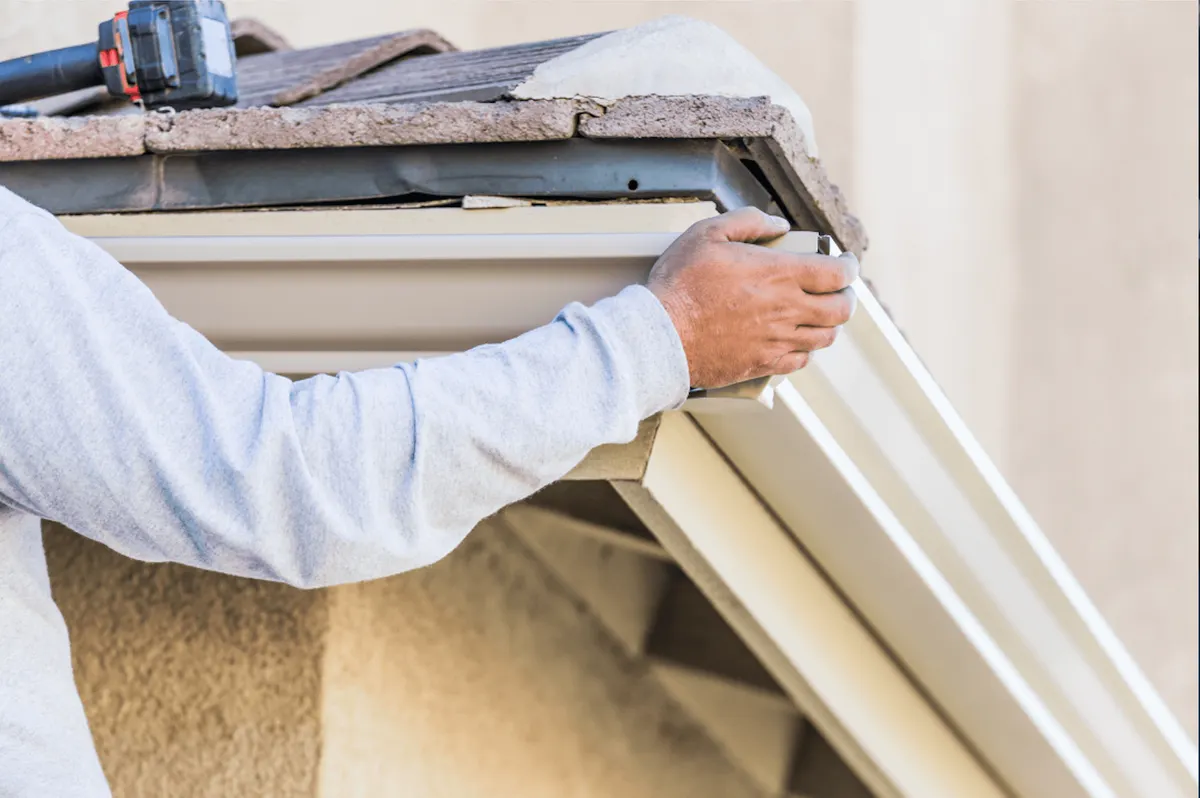
Seamless gutters are roll-formed on-site using a portable gutter machine loaded with continuous coil stock. Each run is fabricated as a single piece — no mid-run seams, no splice joints, no future leak points. On-site fabrication also allows for real-time adjustments if the roofline reveals minor deviations from the original measurements.
Fascia Preparation
Before any gutter is mounted, the fascia board is inspected closely for water damage, wood rot, or termite compromise. Damaged sections are repaired or replaced with treated lumber. On Galveston homes, fascia rot is common due to humidity and prior gutter failures. Skipping this step leads to hangers pulling out of soft wood within a few seasons.
System Installation
Gutters are mounted with hidden hangers fastened into rafter tails at 18- to 24-inch intervals — the hurricane-rated spacing standard for coastal Galveston County. Stainless steel or hot-dipped galvanized structural screws are used rather than aluminum nails or pop rivets. Proper pitch is set at approximately 1/4 inch of slope per 10 feet of gutter run toward each downspout.
Downspout Routing
Downspouts are routed to direct water away from the foundation — a particularly important detail on pier-and-beam homes, where water pooling near supports can cause settling and structural damage over time. Extensions, splash blocks, or underground drain tie-ins are configured based on the yard grade and drainage conditions. Three-by-four-inch downspouts are standard for 6-inch gutter systems.
Final Inspection & Testing
A water test is run through the full system to verify flow rate, pitch accuracy, and leak-free seams. Every hanger, end cap, miter joint, and downspout connection is inspected. The homeowner receives a walk-through of the completed installation with care and maintenance recommendations specific to Galveston's coastal conditions.
Decision Guide
Replace or Repair?
Not every gutter problem requires a full replacement. The following guide helps Galveston homeowners determine whether repair or replacement is the better investment.
When to Replace
- Gutters are standard galvanized steel and the property is on the island or Bolivar Peninsula — rust and structural failure are inevitable
- Multiple sections show visible corrosion, pitting, or paint failure that has reached the base metal
- Hangers are spaced at 36 inches and the system has pulled away from the fascia during storms
- Water damage is present on the fascia behind the gutters, indicating long-term overflow or seam failure
- The gutter system predates Hurricane Ike (2008) and has never been upgraded to coastal-rated fastening standards
- Sectional gutters with multiple leaking seams are present — seam sealant is a temporary fix, not a permanent solution
- Downspouts are undersized (2-by-3-inch) and cannot handle the volume from 6-inch or oversized gutters
When to Repair
- A single section has storm damage (bent, dented, or knocked loose) but the rest of the system is sound
- An isolated leak at an end cap or miter joint that can be resealed without affecting the surrounding gutter
- One or two hangers have loosened and need to be refastened or replaced with structural screws
- A downspout has detached at the elbow or outlet and needs reconnection
- Minor pitch correction is needed to eliminate a standing water section
- Live oak catkins or oleander leaf debris has caused a localized clog rather than a systemic drainage issue
- The gutter material (aluminum, Galvalume, or copper) is in good condition and less than 15 years old
Not Sure Whether to Repair or Replace?
A free on-site inspection provides a clear recommendation based on the current system's condition, material, and remaining lifespan.
(409) 741-9557 Request a Free InspectionCommon Questions
Gutter Installation FAQ
Answers to the most common questions about gutter installation on the Galveston, Texas coast.
Most residential gutter installation projects in Galveston take between 4 and 8 hours for a standard single-story home. Two-story homes, pier-and-beam structures with elevated rooflines, or properties requiring extended downspout routing may take a full day. Larger historic homes in the East End or Silk Stocking District sometimes require two days due to custom fascia work and architectural considerations. Weather conditions along the Gulf Coast can also affect scheduling, as installation crews cannot safely work during active rain or high-wind events.
Gutter installation in Galveston typically costs between $8 and $12 per linear foot for standard seamless aluminum 5-inch gutters. Six-inch seamless aluminum runs $10 to $15 per linear foot, while premium materials like Galvalume range from $10 to $18 and copper from $25 to $45 per linear foot. Coastal properties generally carry a 10 to 20 percent premium over mainland pricing due to the need for marine-grade fasteners, closer hanger spacing, and corrosion-resistant materials. The total cost for an average Galveston home falls between $1,800 and $3,500 depending on material choice, home size, and roof complexity.
Six-inch gutters are the recommended standard for most Galveston properties. The region receives over 50 inches of annual rainfall according to the National Weather Service Houston/Galveston office, and tropical weather systems can produce 2 to 4 inches per hour during peak events. Five-inch gutters may suffice for smaller structures like detached garages or covered patios, but primary roof drainage systems benefit significantly from the added capacity of 6-inch gutters paired with 3-by-4-inch downspouts.
Homeowners do not need to be present for the full installation. However, it is recommended that someone be available at the start of the project to confirm placement details, downspout routing preferences, and any last-minute adjustments. The installation crew will conduct a final walk-through and drainage test upon completion, and the homeowner or their designated representative should be present for that step to approve the finished work.
In hurricane-prone areas like Galveston and the upper Texas coast, gutter hangers should be spaced every 18 to 24 inches. This is significantly tighter than the 36-inch spacing standard in non-coastal regions. Closer hanger spacing prevents gutters from pulling away from the fascia during sustained high winds and heavy rain loads associated with tropical storms and hurricanes. Hidden hangers with structural screws driven into the rafter tails — rather than the fascia board alone — provide the strongest hold and are the recommended fastening method for coastal installations.
Galvalume steel and copper offer the best salt air corrosion resistance for coastal properties. Galvalume — an alloy of aluminum, zinc, and silicon — was specifically engineered for coastal and industrial environments and carries an expected lifespan of 30 to 50 years even in direct salt exposure. Copper naturally develops a protective patina and can last well over 50 years. Painted seamless aluminum also performs well in coastal conditions provided it receives periodic freshwater rinsing to remove salt deposits. Standard galvanized steel is not recommended for island properties, as the zinc coating degrades rapidly in salt air and can begin showing rust within 3 to 5 years.
During a gutter replacement project, the installation crew removes all existing gutters, downspouts, hangers, and fasteners before beginning the new installation. The fascia board is inspected for rot, water damage, or structural compromise, and any necessary repairs are made before new gutters are mounted. All removed materials are hauled away as part of the service. Aluminum and copper gutters are recycled when possible. The crew also inspects the drip edge and makes recommendations if replacement is needed to ensure proper water flow into the new gutter system.