Bayfront Living, Bayfront Challenges
Bacliff and San Leon are two unincorporated communities that together form one of the most distinct residential pockets in Galveston County. Positioned directly on the western shore of Galveston Bay between Dickinson and Kemah, these neighboring communities share a combined population of roughly 10,000 residents and an identity shaped almost entirely by their relationship with the water. Neither community has a city government. Neither has zoning in any formal sense. What they do have is direct, unobstructed bayfront exposure—and that single geographic fact drives nearly every decision about how homes here are built, maintained, and protected from the elements.
San Leon sits at the tip of a small peninsula that juts into Galveston Bay, giving many properties water views on two or even three sides. The community grew up around the commercial fishing and oystering industries, and that heritage remains visible in the boat launches, bait camps, and seafood restaurants that line the waterfront along 2nd Street and Avenue A. Bacliff, immediately to the west, developed along similar lines but sits slightly farther from the bay’s edge in most sections, offering marginally less direct salt exposure while still falling squarely within the coastal corrosion zone.
The Salt Air Reality
Salt-air corrosion is not a secondary consideration in these communities—it is the primary threat to exterior metal surfaces, including gutters. Properties in San Leon that face the bay receive direct salt deposition from the prevailing southeast winds, with concentrations comparable to what beachfront homes on Galveston Island experience. That salt accumulates on aluminum and steel gutter surfaces, works into seams and fastener holes, and initiates the oxidation process that weakens joints and creates pinhole leaks. Standard galvanized steel gutters, still found on many older homes in both communities, can corrode to the point of structural failure within eight to ten years of installation—roughly half the lifespan those same materials would deliver in a protected inland location like Friendswood or Santa Fe.
The housing stock reflects the communities' working-waterfront roots. A significant portion of homes in both Bacliff and San Leon date to the 1960s and 1970s, when modest frame construction on slab foundations was the standard approach. Many of these homes were built without gutters entirely, or with minimal half-round galvanized systems that have long since rusted through. Rooflines tend to be simple—straightforward gable or hip configurations without the valleys and dormers common in newer suburban construction. That simplicity is actually an advantage when it comes to gutter installation: fewer collection points, more straightforward pitch calculations, and less material needed per linear foot of roofline.
Properties in San Leon and Bacliff sit within the most intense salt-air corrosion zone on the Galveston County mainland. Corrosion-resistant materials—aluminum with baked-on enamel or Galvalume alloy—are not premium upgrades in these communities. They are baseline requirements for any gutter system expected to last more than a decade.
Storm Surge: The Ike Legacy
Hurricane Ike made landfall on Galveston Island in September 2008, but some of its most devastating impacts were felt in Bacliff and San Leon. Storm surge from Galveston Bay pushed water levels to between 12 and 15 feet in parts of San Leon, effectively submerging the entire community. Homes were knocked off foundations, walls collapsed, and the debris field extended for miles. Bacliff fared only marginally better, with surge levels reaching 8 to 12 feet in the hardest-hit sections closest to the bay.
The rebuilding that followed Ike reshaped both communities. New construction and substantially rebuilt homes were required to meet updated floodplain regulations, which in most cases meant elevating living spaces on pilings or stem walls to a height of 12 to 16 feet above grade. That elevation changes the gutter equation significantly: downspout runs become much longer, requiring additional bracing and larger-diameter pipe to handle the volume without creating excessive back-pressure. The extended vertical exposure also means that downspouts face greater wind loads during storms, making secure mounting hardware essential rather than optional.
For the many pre-Ike homes that remain—either because they survived the storm or were repaired rather than rebuilt—gutter maintenance takes on an urgency that goes beyond simple cosmetic upkeep. A failed gutter system on a low-elevation bayfront home channels water directly against the foundation slab, accelerating the soil erosion and settling that already threatens structures in this flood-prone geography. In communities where the next storm surge is always a matter of when rather than if, every component of the drainage system earns its place.
Property Landscape
The housing stock across Bacliff and San Leon defies easy categorization, largely because both communities developed without formal zoning or master planning. What exists today is a mosaic of waterfront fishing camps, full-time single-family residences, post-Ike elevated construction, and everything in between. Understanding this landscape helps explain why gutter solutions must be evaluated property by property rather than applied in a one-size-fits-all fashion.
Fishing Camps and Waterfront Cottages
San Leon in particular retains a strong inventory of what locals call fishing camps—small, often one-bedroom structures originally built as weekend retreats for Houston-area anglers. Many of these camps sit on narrow lots along the bayfront streets, with direct water access or shared pier facilities. Construction quality varies enormously. Some camps have been carefully maintained or renovated into comfortable full-time residences. Others remain bare-bones structures with original materials that have endured decades of salt exposure.
Gutter systems on these properties, when they exist at all, are frequently the original galvanized half-round installations from the 1960s or 1970s. Corrosion has typically advanced to the point where patching individual sections is impractical—the metal has thinned uniformly, meaning that fixing one leak simply shifts the failure point to the next weakest seam. For these properties, a full replacement with modern seamless aluminum represents the most cost-effective approach. The compact rooflines common on fishing camps keep material costs manageable, often making a complete gutter system replacement less expensive than homeowners expect.
Post-Ike Elevated Construction
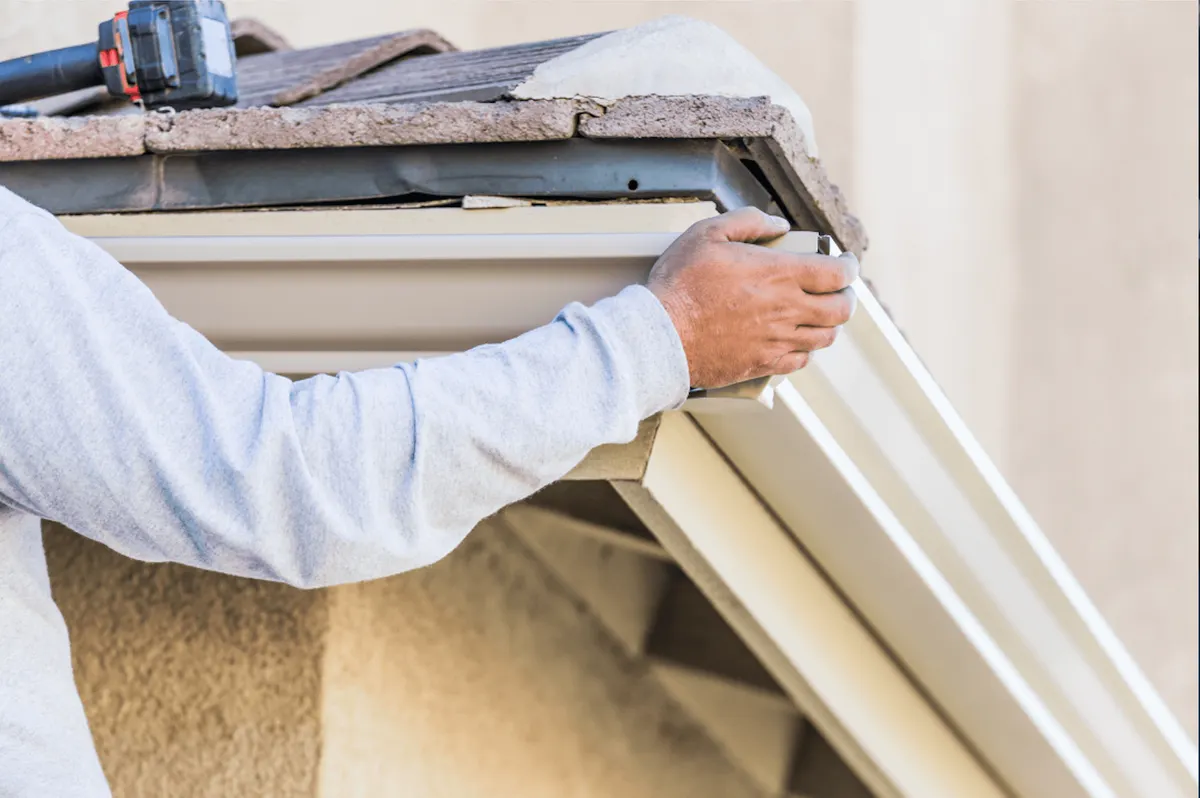
The most visible change in both communities since 2008 is the proliferation of elevated homes. New construction and substantially improved properties now sit 12 to 16 feet above grade on engineered piling systems, transforming what were once ground-level neighborhoods into communities of raised structures with ground-floor parking and storage beneath the living space. These elevated homes present specific gutter challenges. Downspout runs from roof edge to grade are considerably longer than on traditional slab-on-grade homes, requiring careful diameter selection and additional mid-run bracing to prevent separation during high winds. The extended exposure of these long downspout runs to salt air also means that corrosion-resistant materials become even more important—a failure point 14 feet above grade is far more difficult and expensive to repair than one at conventional height.
Full-Time Residences
Between the fishing camps and the elevated new builds sits a middle category: modest full-time residences, typically three-bedroom homes on slab foundations built during the 1970s through 1990s. These properties form the backbone of both communities and represent the largest share of the gutter service demand in Bacliff and San Leon. Many need complete gutter system replacements after decades of salt exposure that has pushed original materials past their functional limits. Others need targeted repairs to address specific failure points—sagging sections where hanger spacing was too wide for coastal wind loads, joint separations caused by thermal expansion, or end-cap corrosion that allows water to run behind the gutter and down the fascia.
Across all property types, the material recommendation remains consistent: corrosion-resistant aluminum with factory-applied enamel coating, or Galvalume alloy for properties with the most direct bay exposure. Standard galvanized steel, while cheaper at the point of purchase, simply does not deliver acceptable longevity in these bayfront communities. The math favors investing in the right material from the start rather than replacing a budget system in half the time.
Gutter Services for Bacliff & San Leon Homes
Every service is tailored to the direct bay exposure, salt-air corrosion, and storm surge risks that define these bayfront communities.
Gutter Installation
Seamless aluminum and Galvalume systems built for direct Galveston Bay salt exposure. Properly sized for compact fishing camp rooflines and engineered for the extended downspout runs on post-Ike elevated construction.
Learn More →Gutter Repair
Targeted fixes for salt-corroded joints, wind-loosened hangers, and sagging sections on bayfront properties. Honest assessment of whether repair or full replacement makes more financial sense given the corrosion level.
Learn More →Gutter Cleaning
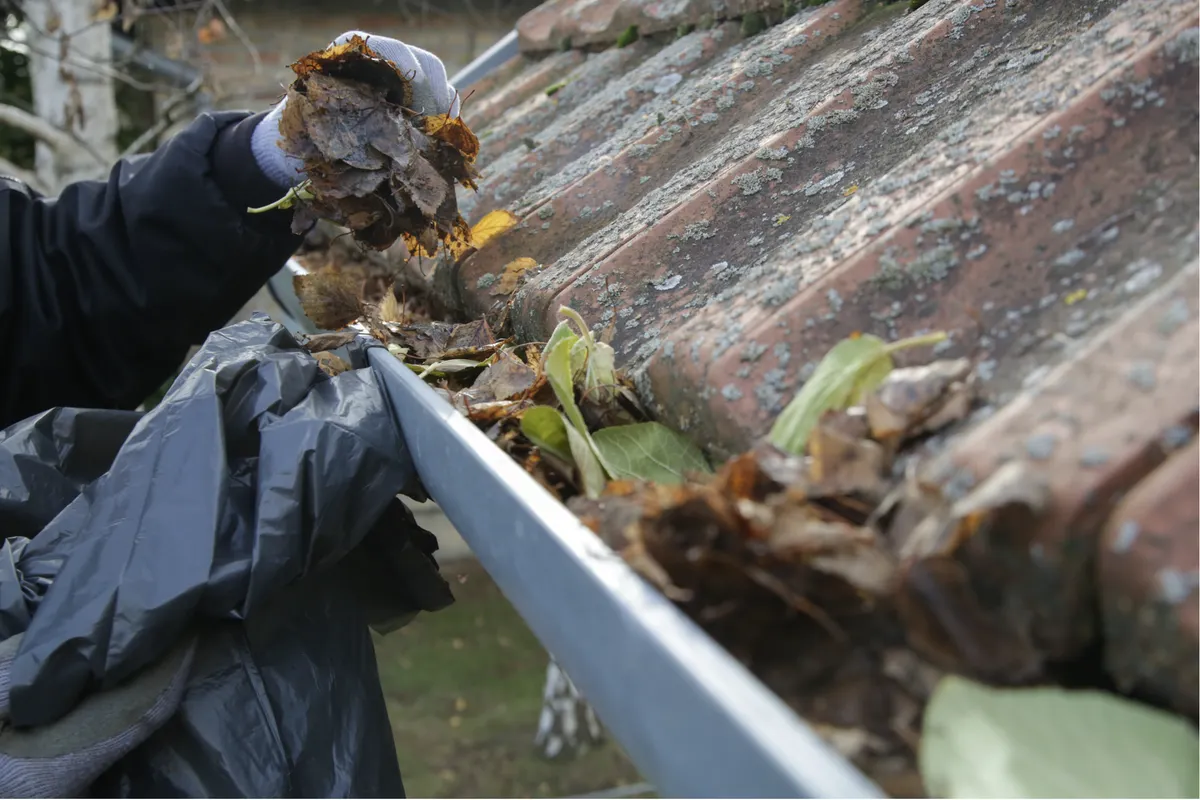
Seasonal cleaning that removes salt crust, live oak debris, and bay-blown sediment. Every visit includes a fresh-water rinse to clear salt deposits and a corrosion inspection of all seams and fasteners.
Learn More →Gutter Guards
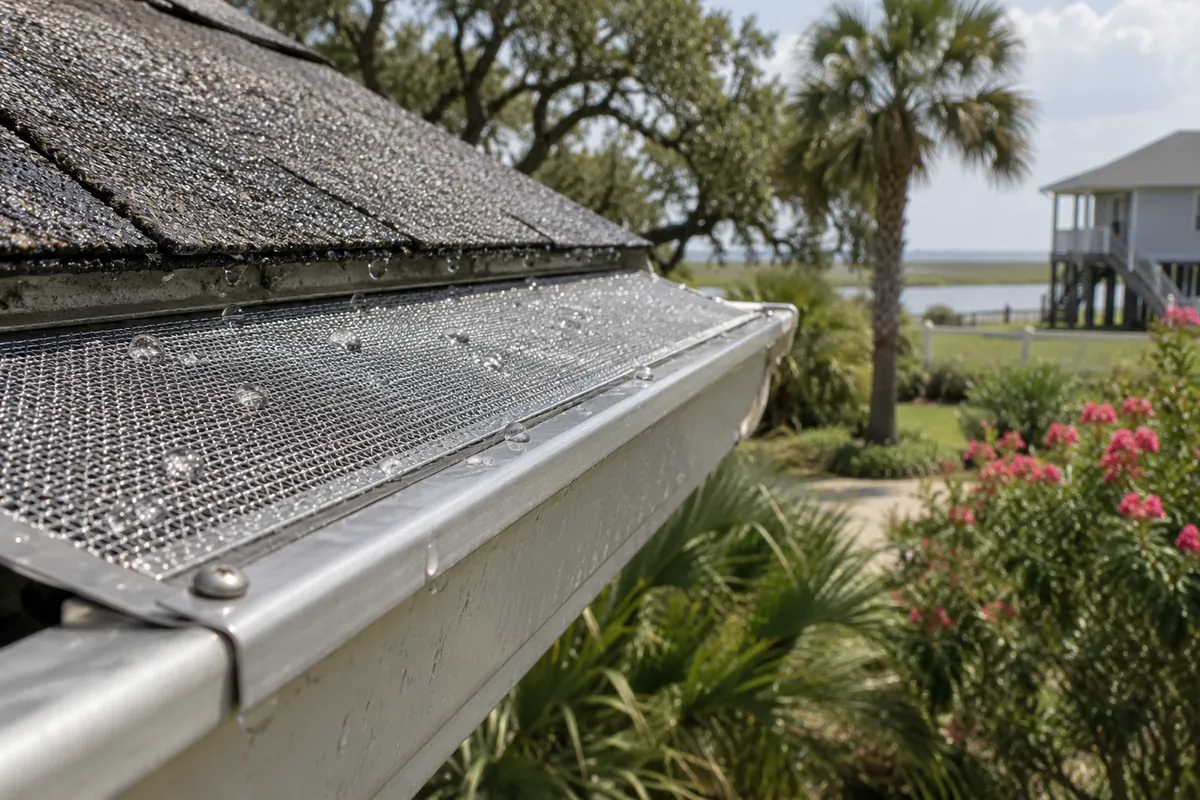
Marine-grade micro-mesh guard systems that block bay debris and wind-blown sediment while maintaining full water flow during intense Gulf Coast downpours. Corrosion-resistant hardware rated for salt-air environments.
Learn More →Downspout Services
Specialized solutions for the extended downspout runs on elevated bayfront homes. Proper diameter selection, mid-run bracing for wind loads, and discharge routing that moves water away from pilings and foundation pads.
Learn More →Ready to Protect Your Bayfront Property?
Free estimates with transparent pricing—no pressure, no hidden fees.
Why Bacliff & San Leon Gutters Work Harder
Direct Galveston Bay salt exposure, devastating storm surge history, fifty inches of annual rainfall, and relentless humidity create one of the most demanding environments for gutter systems on the Texas coast.
Living directly on Galveston Bay means living in a salt-air environment that never lets up. The prevailing southeast wind carries moisture laden with sodium chloride across the open water and deposits it on every exterior surface in Bacliff and San Leon. Unlike communities set a few miles inland—where trees, buildings, and distance dilute salt concentrations before they reach homes—these bayfront properties receive nearly the same salt load as structures on Galveston Island itself. That persistent deposition accelerates corrosion on metal gutters, fascia hardware, and downspout brackets in ways that homeowners who have only lived inland may not anticipate. A gutter system that performs flawlessly for fifteen years in League City or Friendswood may show visible pitting and joint deterioration within seven to eight years in San Leon.
Storm surge represents the most dramatic threat these communities face. Hurricane Ike in 2008 pushed Galveston Bay water 12 to 15 feet above normal levels through San Leon and 8 to 12 feet through Bacliff, devastating both communities. Homes were ripped from foundations, and virtually every gutter system in the surge zone was destroyed. The rebuilding process introduced elevated construction standards that now define new homes in both communities, but thousands of pre-Ike slab-on-grade structures remain. For those ground-level properties, functional gutter systems are a critical line of defense—directing the 50 inches of annual rainfall away from foundations that sit in a geography where the next surge event is a statistical certainty.
Annual rainfall in the Bacliff and San Leon area averages approximately 50 inches, with the heaviest concentrations falling between May and October. Gulf Coast thunderstorms routinely deliver two to four inches in a single afternoon, overwhelming any gutter system that is undersized, partially clogged, or pitched incorrectly. The flat terrain that characterizes both communities offers almost no natural drainage grade, meaning that every drop of water landing on a roof must be captured, channeled through gutters, and directed via downspouts to a discharge point far enough from the structure to prevent foundation pooling.
Humidity compounds every other challenge. Galveston Bay maintains relative humidity levels above 80 percent for much of the year, creating conditions where moisture rarely evaporates completely from gutter surfaces. That persistent dampness accelerates the corrosion process on metal components and encourages biological growth—algae, mold, and mildew—inside gutter channels that can restrict flow and add weight to aging hangers. Regular cleaning paired with corrosion-resistant materials is the only reliable formula for long-term gutter performance in these bayfront communities.
Bacliff & San Leon Quick Facts
- Annual Rainfall: ~50 inches, concentrated May–October
- Hurricane Ike Surge: 12–15 ft in San Leon; 8–12 ft in Bacliff
- Salt Exposure: Direct bay frontage; comparable to island properties
- Terrain: Flat; essentially no natural drainage grade
- Humidity: 80%+ average; accelerates corrosion year-round
- Peak Storm Season: June through November
- Population: ~10,000 combined (unincorporated)
- Corrosion Timeline: 7–8 years (bayfront) vs. 12–15 years inland
Nearby Communities Also Served
Galveston Clean Gutters serves Bacliff, San Leon, and neighboring communities throughout Galveston County.
Protect Your Bayfront Home from Salt Air Damage
Direct bay exposure, storm surge risk, and fifty inches of rain demand gutter systems built for the real conditions of these waterfront communities. Connect with a qualified contractor today.
(409) 741-9557